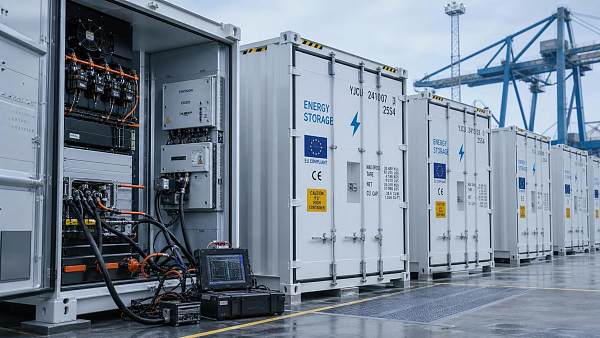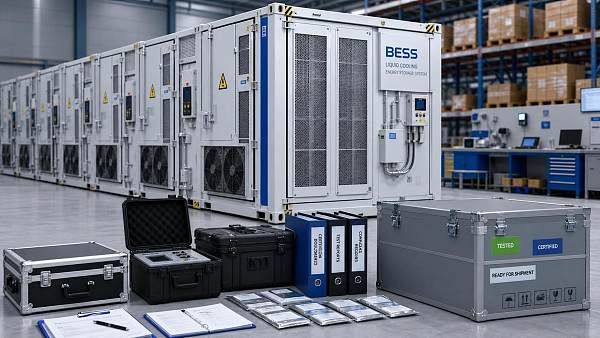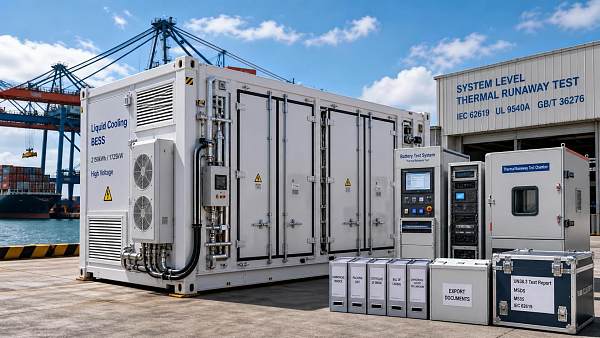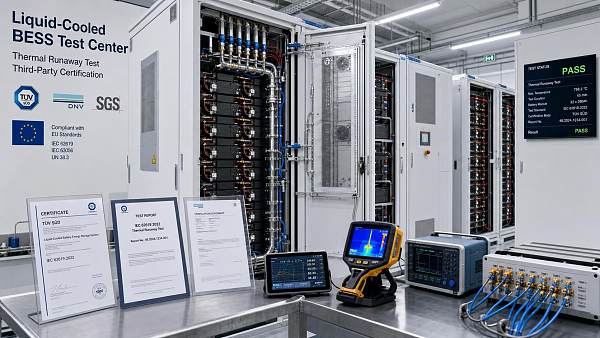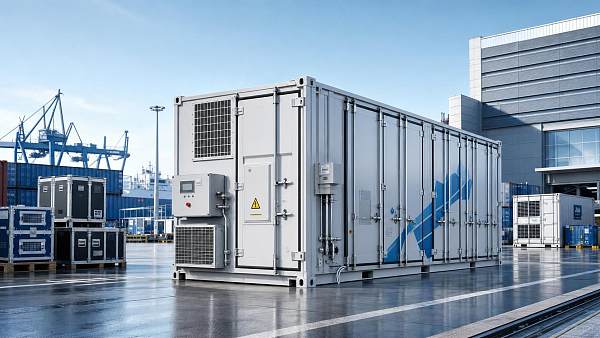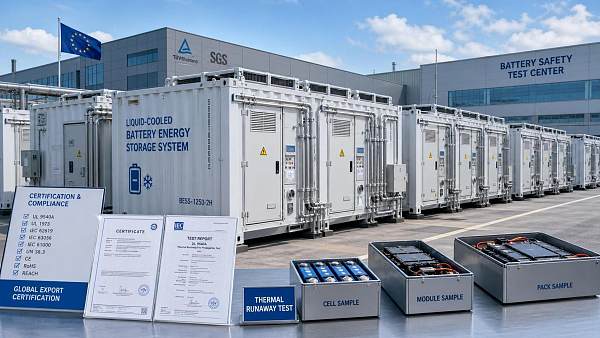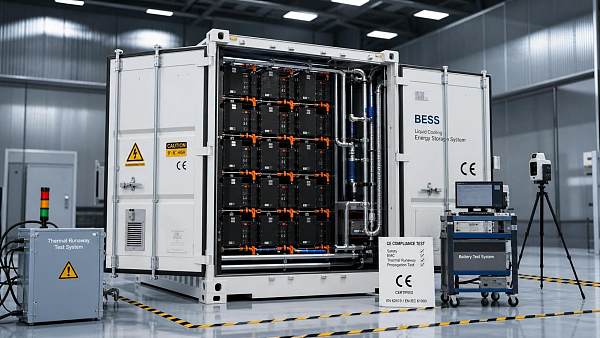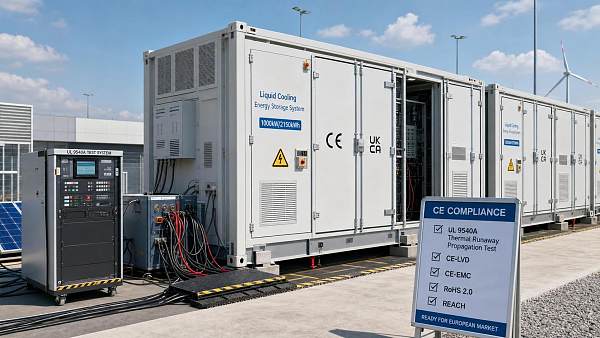
On July 24, 2026, the European Commission released the revised draft Green Grid Equipment Market Access proposal (COM/2026/412), introducing a new compliance direction for imported liquid-cooled BESS containers from October 2026. The draft would require certified real-time thermal runaway propagation monitoring modules to be integrated before shipment and would also require a verifiable digital twin interface. For BESS manufacturers, OEMs, exporters, and project-facing supply chain teams, this is worth close attention because it shifts a safety-related requirement from later-stage certification into product design and factory delivery preparation.
What the Draft Formally Introduces
According to the information provided, the European Commission published COM/2026/412 on July 24, 2026. The draft places the UL 9540A Tier 3 thermal runaway propagation certification requirement earlier in the process, moving it into the product design and ex-factory stage for imported liquid-cooled BESS containers. It requires those products to include a certified real-time thermal runaway propagation monitoring module and to provide a verifiable digital twin interface.
The same information indicates that the draft directly affects the export compliance pathway for Chinese BESS manufacturers. It is also stated that OEMs may need to restructure the coordinated architecture across BMS, PCS, and cooling systems, with an estimated bill-of-materials increase of about 7.3% and an added certification adaptation period of four to six weeks.
Where the Pressure Is Likely to Appear First
Export-facing manufacturers will face earlier design-stage compliance work
From an industry perspective, manufacturers serving the EU market are likely to feel the impact first because the draft links market access to configuration decisions made before products leave the factory. The main pressure point is no longer limited to documentation at delivery; it moves into product architecture, module integration, and validation planning.
OEM system integration becomes a practical bottleneck
Analysis shows that OEMs are exposed at the system level because the requirement touches the interaction between BMS, PCS, and cooling systems. The issue is not only whether a monitoring module is present, but whether the overall system architecture can support the required monitoring and the associated digital twin interface in a verifiable way.
Supply chain and certification service roles may see timing risk
Observably, suppliers and service providers involved in compliance preparation, technical documentation, and certification adaptation may be affected through schedule compression. The stated four-to-six-week adaptation cycle suggests that delivery planning, documentation readiness, and coordination between component and system parties could become more sensitive for EU-bound projects.
Procurement and project buyers may focus more on pre-shipment readiness
For procurement teams and downstream buyers, the draft may shift attention toward supplier readiness before order confirmation and shipment. What deserves closer attention is whether the supplier can demonstrate that the monitoring module and digital twin interface are already built into the export configuration, rather than treated as a later modification item.
What Companies Should Watch in the Near Term
Track how the draft language evolves into enforceable wording
Because the current information concerns a draft, companies should pay close attention to whether the final wording changes the scope, timing, or proof requirements tied to imported liquid-cooled BESS containers. The distinction between draft language and final enforceable rules matters for compliance planning and customer commitments.
Review EU-bound product configurations now
Manufacturers and exporters should examine which product lines are tied to the EU market and whether current liquid-cooled BESS configurations already support certified real-time thermal runaway propagation monitoring and a verifiable digital twin interface. This is especially relevant where existing export models were built around a later-stage certification workflow.
Recheck supplier qualifications and document packages
What deserves closer attention is the readiness of component suppliers and integration partners to support the required evidence chain. In practice, this includes qualification status, technical documentation, interface consistency, and the ability to support customer-facing compliance communication without creating delay at order, inspection, or delivery stages.
Prepare for cost and lead-time discussions with customers
The provided information points to an estimated 7.3% increase in BOM cost and a four-to-six-week certification adaptation period. Companies involved in quoting, contracting, and project scheduling should treat these as practical issues for customer communication and internal planning, especially for shipments tied to the EU market access timeline referenced in the draft.
Why This Looks Like More Than a Routine Compliance Update
Analysis shows that this development is better understood as a structural compliance signal rather than a narrow paperwork revision. The requirement, as described, brings thermal runaway propagation monitoring and digital verification closer to the front end of product development. That changes the commercial meaning of compliance: it becomes embedded in design choices, supplier coordination, and factory readiness.
At the same time, it is more appropriate to understand this as an industry dynamic that still requires observation, because the information provided refers to a draft rather than a finalized rule text. The direction is clear enough to affect preparation, but the eventual implementation details still matter for how widely and how quickly companies will need to adjust.
How This News Is Best Interpreted Now
At this stage, the draft signals that EU market access for imported liquid-cooled BESS may become more tightly linked to pre-installed safety monitoring capability and verifiable digital interfaces. For the industry, the immediate significance is not only the added hardware and certification burden, but the earlier point at which compliance must be built into the product. A neutral reading is that this is both a short-term operational issue for export planning and a longer-term signal about how safety and digital verification may be integrated into market access expectations.
Basis of This Article
This article is based on the user-provided news title, event date, and event summary concerning the European Commission's July 24, 2026 draft proposal COM/2026/412. For this type of industry update, relevant source categories typically include official government releases, company disclosures, industry association updates, authoritative media reporting, and standards-related documentation. No specific official source link was provided in the input, so the exact official link remains to be verified on an ongoing basis. Continued attention should focus on whether the draft wording changes, how implementation timing is finalized, and how compliance proof requirements are ultimately defined for imported liquid-cooled BESS products.
Related News
 EU Draft Targets Liquid-Cooled BESS ImportsGrid Storage ArchitectEU draft targets liquid-cooled BESS imports with new thermal runaway monitoring and digital twin rules. Learn the compliance impact, cost risks, and how exporters can prepare now.
 DOE Rule Raises Entry Bar for Liquid-Cooled BESSGrid Storage ArchitectDOE rule raises the entry bar for liquid-cooled BESS in the U.S. Learn how UL 9540A Tier 3 testing and third-party verification now impact customs clearance, compliance, and delivery.
 DOE Sets UL 9540A Rule for Liquid-Cooled BESS ImportsGrid Storage ArchitectDOE sets a new UL 9540A rule for liquid-cooled BESS imports to the U.S. Learn what changes on August 1, 2026, and how exporters can avoid delays, compliance gaps, and testing risks.
 EU Tightens EN 50641 for Liquid-Cooled BESSGrid Storage ArchitectEU Tightens EN 50641 for Liquid-Cooled BESS: learn how the new UL 9540A 4th edition test and third-party certification rule affects EU market access, compliance timelines, and export planning.
 EU Sets UL 9540A Rule for Imported Liquid-Cooled BESSGrid Storage ArchitectEU sets UL 9540A rule for imported liquid-cooled BESS. Learn how the October 2026 EU requirement impacts compliance, certification timelines, costs, and delivery planning.
 EU Sets New Thermal Runaway Test Rule for Liquid-Cooled BESSGrid Storage ArchitectEU Sets New Thermal Runaway Test Rule for Liquid-Cooled BESS: learn how UL 9540A Tier 3 and EN 50620:2025 requirements may impact EU market access, timelines, and compliance costs.
 How to Evaluate a Containerized Battery Storage ManufacturerGrid Storage ArchitectContainerized battery storage manufacturer selection starts with safety, thermal control, and integration. Learn how to compare suppliers, cut lifecycle risk, and choose with confidence.
 EU CE Rule Takes Effect for Liquid-Cooled BESS TestingGrid Storage ArchitectEU CE rule for liquid-cooled BESS testing now requires UL 9540A thermal runaway reports for new filings. Learn how this impacts compliance, exports, and market access in Germany and the Netherlands.
 IEC 62933-5-2 Sets New EU Export Test Rule for Liquid-Cooled BESSGrid Storage ArchitectIEC 62933-5-2 introduces a new EU export test rule for liquid-cooled BESS. Learn how CE certification, UL 9540A-equivalent reports, and 2027 compliance deadlines may affect delivery plans.
 Top Utility-Scale Energy Storage Manufacturers in the USA for 2026 ProjectsGrid Storage ArchitectUtility scale energy storage manufacturers USA for 2026 projects: compare top suppliers by safety, grid controls, warranties, and service to choose a bankable BESS partner.
 EU Aligns CE Rules With UL 9540A for Liquid-Cooled BESSGrid Storage ArchitectEU Aligns CE Rules With UL 9540A for liquid-cooled BESS: learn how the new EU CE conformity update impacts compliance, procurement timing, and market access from Q4 2026.
 Thermal Runaway Protection: Common Gaps in BESS Safety DesignGrid Storage ArchitectThermal runaway protection in BESS: uncover the hidden safety design gaps behind compliance, from detection and isolation to venting and propagation control, before they impact uptime and project risk.