On 2026-07-04, Japan’s Ministry of Economy, Trade and Industry (METI) introduced a faster conformity assessment route for V2G bidirectional chargers that meet JIS C 8201-7-1, a standard aligned with IEC 61851-23. For manufacturers, importers, EV fleet operators, utility-side project partners, and certification-related service providers, the change matters because it shortens the usual certification timeline while also making specific technical capabilities part of the entry condition for eligible products. What deserves closer attention is that the time benefit is tied to compliance content, not simply to administrative acceleration.
What METI Confirmed on 2026-07-04
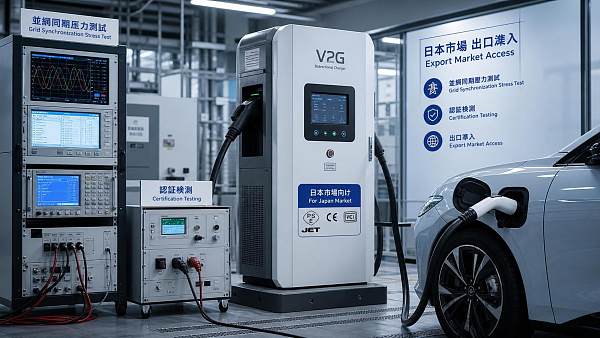
According to the information provided, METI announced an expedited conformity assessment path for V2G bidirectional chargers on 2026-07-04. The route applies to models that meet JIS C 8201-7-1, which is aligned with IEC 61851-23.
The stated change reduces the typical certification period from 14 weeks to 6 weeks. The information provided also states that eligible models must include real-time grid frequency response logging and cyber-resilient firmware.
These eligibility points were identified as key criteria for Japanese EV fleet operators and utility partners importing products from China and Korea.
Why the Rule Change Reaches Beyond Certification Lead Time
For charger manufacturers and exporters
Analysis shows the immediate effect is not only a shorter approval window, but a clearer product qualification threshold. Manufacturers shipping V2G bidirectional chargers into the Japanese market may need to verify whether their current models actually include the required real-time grid frequency response logging and cyber-resilient firmware, because the accelerated route appears to depend on those features being present. For exporters, this shifts attention toward product specification alignment, test preparation, and technical document readiness before shipment or bidding.
For importers, fleet operators, and utility-side buyers
From an industry perspective, buyers in Japan may treat the fast-track path as a procurement filter rather than just a regulatory convenience. If project timing depends on certification speed, importers, fleet operators, and utility partners may place greater weight on whether a charger model can qualify for the 6-week path. In practical terms, procurement teams may need to review technical submissions, certification status, firmware-related documentation, and compliance claims more closely when comparing suppliers from China and Korea.
For testing, certification, and delivery planning
Observably, the change could affect how certification-related service providers and supply chain coordinators schedule work. A shorter stated certification cycle may compress testing preparation, file submission, model selection, and delivery sequencing. At the same time, companies should not assume that a shorter route removes the need for evidence. The rule change, as provided, points in the opposite direction: faster access appears linked to more specific qualification conditions.
What Companies Should Review Now
Check whether product specifications match the fast-track threshold
Analysis shows that companies should first confirm whether their V2G bidirectional charger models meet JIS C 8201-7-1 and whether the required functions are already built into the product. Where internal product definitions or bid documents use broader V2G language without these specific features, those materials may need review to avoid treating general V2G capability as equal to fast-track eligibility.
Prepare technical files around logging and firmware resilience
What deserves closer attention is the documentation burden implied by the eligibility criteria. Even though the provided information does not describe the full submission package, companies involved in certification, import compliance, or customer qualification should pay close attention to test records, technical descriptions, firmware-related materials, and any supporting evidence tied to real-time grid frequency response logging and cyber-resilient firmware.
Revisit procurement and delivery assumptions
For buyers and suppliers, the reported reduction from 14 weeks to 6 weeks may influence project timing, but it should not be treated as a guaranteed outcome for every model. It is more appropriate to understand this as a conditional pathway linked to standard compliance and product capability. Procurement plans, delivery commitments, and tender responses may therefore need to distinguish between products that are merely intended for the Japanese market and products that are positioned to qualify for the accelerated route.
Monitor how the rule is reflected in market documents
Observably, one practical area to watch is how this change appears in later compliance instructions, certification communications, purchasing specifications, and tender language. The information provided confirms the route and the eligibility criteria, but it does not set out the full operating interpretation. Companies should therefore follow whether market-facing documents begin to treat these features as expected baseline requirements rather than optional differentiators.
How This Signal Should Be Read
From an industry perspective, this update is best read as a concrete execution signal rather than a broad policy slogan. The reason is that the announcement combines a measurable process change, namely a shorter certification timeframe, with defined technical conditions for access to that route. At the same time, analysis shows it should not yet be treated as a complete picture of market practice, because the provided information does not include detailed implementation language, document lists, or downstream procurement rules.
That is why continued attention matters. Industry participants are not only watching certification speed; they are also watching whether compliance expectations in Japan become more tightly connected to grid-response traceability and firmware resilience in actual purchasing and project execution.
What the Update Means at This Stage
At this stage, the development is more appropriately understood as an implemented rule change with immediate relevance for certification planning, product qualification, and cross-border supply into Japan’s V2G charger market. The practical significance lies in the fact that the faster route is paired with explicit technical eligibility points, which can influence supplier selection, bid readiness, and delivery planning.
A neutral reading is that the announcement creates a clearer near-term compliance signal, while leaving room for further observation on how consistently the criteria are applied in certification practice and market procurement. For companies tied to exports, imports, testing, or project delivery, the main task now is to separate confirmed requirements from assumptions and align product and document readiness accordingly.
Basis of This Article
This article is based on the user-provided news title, event date, and event summary concerning METI’s 2026-07-04 announcement on the expedited conformity assessment path for V2G bidirectional chargers under JIS C 8201-7-1.
For developments of this kind, source types commonly relevant to later verification include official government announcements, regulator releases, trade or customs authority information, standards organization documents, industry association materials, certification-related notices, and reporting by established professional media. No specific official source link was provided in the input, so the official reference path still needs to be checked on an ongoing basis.
Further observation should focus on whether additional implementation details emerge regarding certification interpretation, supporting technical documentation, tender wording, market feedback, and how companies actually execute against the announced requirements.
Related News
 Japan Opens Faster V2G Charger CertificationEV Infrastructure ExpertJapan opens faster V2G charger certification with METI’s new 6-week path. See how JIS C 8201-7-1 compliance, firmware resilience, and grid-response logging impact market access.
 Japan Tightens V2G Charger Grid Entry RulesEV Infrastructure ExpertJapan Tightens V2G Charger Grid Entry Rules: learn how Japan’s new V2G bidirectional charger compliance, JET certification, and IEEE 1547-2024 Rev.2 rules may impact launch timing and market access.
 Vehicle to Grid System Basics: Benefits, Limits, and Real Use CasesEV Infrastructure ExpertVehicle to grid system basics made clear: explore key benefits, real limits, and practical use cases for fleets, homes, and grid support before you invest.
 CBP Clarifies HTS Code for V2G ChargersEV Infrastructure ExpertCBP clarifies the HTS code for V2G chargers, shifting qualifying models to HTS 8504.40.95 with a 3.7% tariff and DOE cybersecurity certification. See who is affected and what to review now.
 DOE Extends Cybersecurity Mandate to V2G ChargersEV Infrastructure ExpertDOE extends cybersecurity rules for V2G chargers, requiring NIST SP 800-207A and UL 1998 compliance by Aug. 31, 2026. See how this impacts procurement, IRA tax credits, and U.S. market access.
 DOE V2G Vendor List Adds 7 Chinese PCS FirmsEV Infrastructure ExpertDOE V2G Vendor List adds 7 Chinese PCS firms, reshaping U.S. utility and municipal EV tenders. See what it means for certification, bidding, compliance, and project delivery.
 DOE Opens Fast-Track for V2G ChargersEV Infrastructure ExpertDOE opens a fast-track for V2G chargers, cutting federal procurement to 9 working days. See how certification, approved vendors, and 3-year service support could reshape U.S. market access.
 FERC Rule Takes Effect for VPP-Connected V2G DevicesEV Infrastructure ExpertFERC Rule takes effect for VPP-connected V2G devices, making UL 1998, IEC 62443-4-2, and firmware hash-chain compliance critical for market settlement. See who is affected now.
 FERC 2222 Rules Take Effect, Raising V2G Certification BarEV Infrastructure ExpertFERC 2222 rules now raise the V2G certification bar, making UL 1998 and IEC 62443-4-2 key to VPP market access. See how exporters and buyers can stay bid-ready.
 FERC Rule Tightens V2G Entry for U.S. VPPsEV Infrastructure ExpertFERC Rule Tightens V2G Entry for U.S. VPPs: learn how UL 1998, IEC 62443-4-2, and FCC-recognized lab reports may reshape market access, interconnection, and export readiness before Oct. 1, 2026.
 FERC Sets Dual Certification Rule for VPP ResourcesEV Infrastructure ExpertFERC Sets Dual Certification Rule for VPP Resources: learn how UL 1998 and IEC 62443-4-2 now affect VPP market access, PJM/NYISO eligibility, and compliance planning before Oct. 1, 2026.
 FERC Sets Dual-Certification Rule for VPP Grid EntryEV Infrastructure ExpertFERC dual-certification rule reshapes VPP grid entry in U.S. wholesale markets. See how UL 1998 and IEC 62443-3-3 affect V2G, storage, aggregators, and compliance planning.