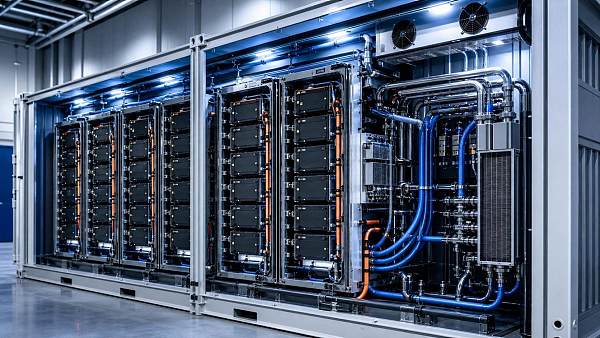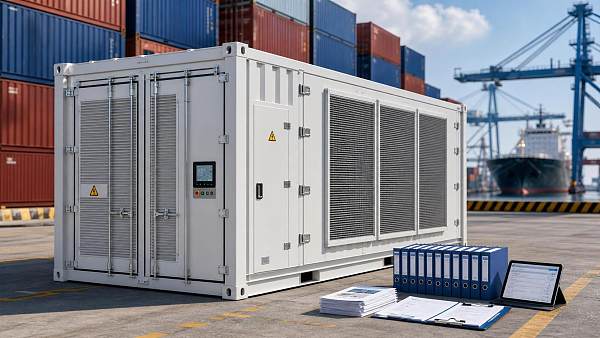
Why Liquid Cooling BESS Safety Risks Need a Checklist Approach
As utility-scale storage expands, understanding liquid cooling BESS safety risks is no longer optional for quality and safety teams. While liquid cooling BESS improves thermal consistency and efficiency, it also introduces critical concerns such as coolant leakage, insulation failure, thermal runaway propagation, and fire protection complexity. This article explains the key hazards, compliance checkpoints, and risk-control priorities that matter most in real-world grid-scale deployments.
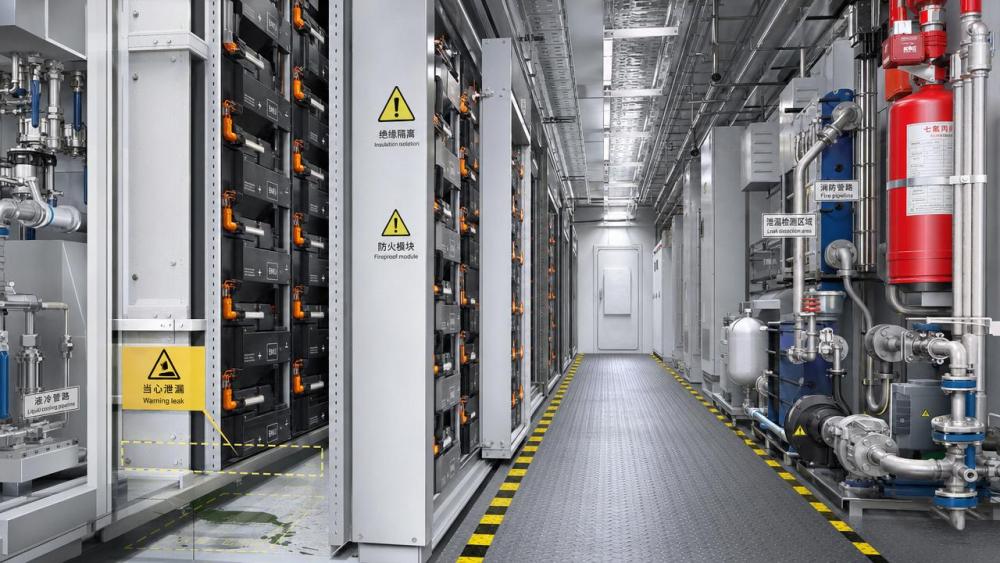
A checklist-based review is essential because liquid cooling BESS combines electrochemistry, fluid systems, controls, power electronics, and fire protection in one enclosure. A failure rarely stays isolated.
In grid-scale projects, minor deviations in coolant quality, sealing, sensor calibration, or drainage design can escalate into shutdowns, warranty disputes, or serious safety events. Structured checks reduce blind spots.
Core Liquid Cooling BESS Safety Checklist
Use the following checklist to assess liquid cooling BESS risk before commissioning, during operation, and after any alarm, retrofit, or abnormal maintenance event.
- Verify coolant compatibility with cell materials, hoses, seals, pumps, and cold plates to prevent corrosion, swelling, contamination, dielectric breakdown, or long-term material degradation.
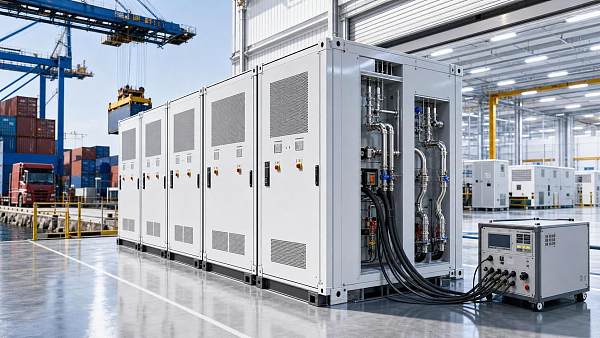
- Inspect leak paths around manifolds, quick connectors, welds, valve blocks, and service ports, then confirm drainage routes keep liquid away from live electrical zones.
- Check insulation coordination between battery racks, coolant loops, busbars, and enclosures, especially under condensation, splash exposure, or degraded coolant conductivity conditions.
- Confirm temperature uniformity across modules, because liquid cooling BESS loses its main safety advantage when flow imbalance creates hidden hot spots.
- Test pump redundancy, power backup, and fail-safe logic so cooling continues or controlled shutdown starts immediately after pump failure, sensor loss, or controller error.
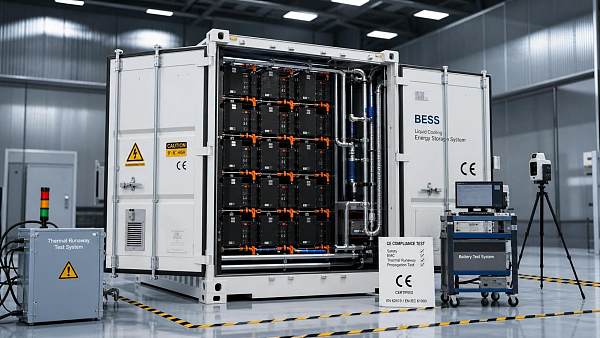
- Review thermal runaway detection layers, including gas sensing, cell temperature trend analysis, pressure rise monitoring, and abnormal voltage divergence within strings.
- Validate thermal runaway propagation barriers between modules and racks, since liquid cooling BESS does not automatically stop flame spread or off-gas ignition.
- Audit fire suppression interaction with coolant piping, cable routing, vent panels, and pressure relief paths to avoid blocked discharge or ineffective agent distribution.
- Confirm BMS, EMS, and HVAC control logic share alarm priorities correctly, so operators are not misled by temperature recovery while internal faults continue worsening.
- Measure coolant quality regularly, including conductivity, pH, particulate level, inhibitor health, and contamination history, because degraded coolant can become a safety hazard.
- Simulate abnormal operating states such as low ambient startup, high ambient peak cycling, islanded standby, and repeated fast charge-discharge duty profiles.
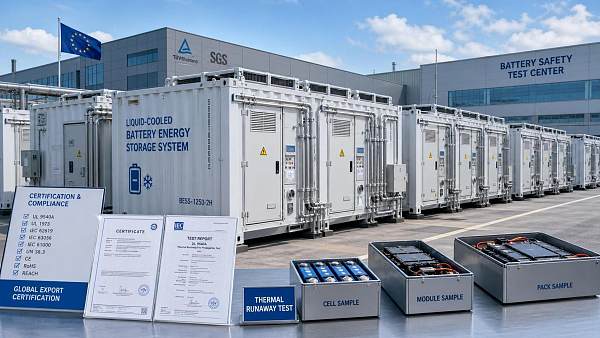
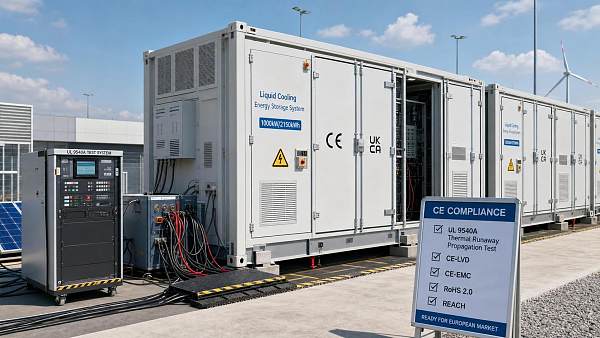
- Document compliance evidence for UL 9540, UL 9540A, NFPA 855, IEC pathways, and local grid fire codes before export, installation, and insurance review.
Key Safety Risks Explained
1. Coolant leakage is not a minor maintenance issue
In a liquid cooling BESS, even a small leak can bridge insulation gaps, wet connectors, or corrode metallic parts over time. The risk increases when leak detection is delayed.
Leakage also creates misleading symptoms. Operators may first see reduced cooling performance, then temperature spread, then insulation alarms. By then, root-cause localization becomes difficult.
2. Insulation failure can develop quietly
Liquid cooling BESS designs depend on stable separation between coolant circuits and energized components. If coolant conductivity rises or condensation forms, insulation margins may shrink below safe levels.
This failure mode is dangerous because it may not trigger immediate shutdown. Instead, it can produce intermittent faults, nuisance trips, or gradual damage to monitoring hardware.
3. Thermal runaway can still propagate
Liquid cooling BESS improves temperature control during normal operation, but it does not eliminate internal cell defects, mechanical abuse, or latent manufacturing flaws.
Once thermal runaway starts, cooling plates may delay heat spread in some layouts, yet flammable gas release, pressure effects, and adjacent module heating can still drive propagation.
4. Fire protection becomes more complex, not simpler
A liquid cooling BESS includes additional piping, pumps, valves, and compartment geometry. These can complicate clean-agent dispersion, aerosol paths, ventilation strategy, and emergency access.
Effective design must coordinate gas detection, off-gas venting, deflagration relief, suppression timing, and post-event isolation. Treating cooling and fire systems separately is a common mistake.
Scenario-Based Checks for Real Deployments
Utility-scale solar plus storage sites
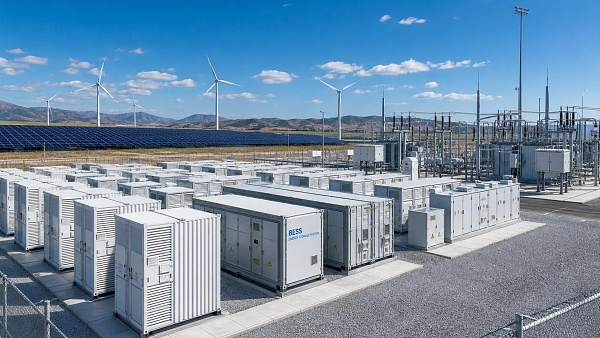
These projects often face harsh daytime heat, dust ingress, and strong cycling during evening peak dispatch. Liquid cooling BESS performance depends on stable heat rejection under high thermal loading.
Focus on pump duty margins, heat exchanger fouling, coolant aging, and temperature distribution across long rack arrays. Dust-related maintenance delays often undermine thermal reliability.
Wind-linked storage in cold or coastal regions
Cold starts can increase coolant viscosity and strain pumps. Coastal humidity raises condensation and corrosion exposure. In these cases, liquid cooling BESS safety depends on environmental adaptation.
Check low-temperature startup logic, anti-condensation control, enclosure sealing, and salt-fog durability. A thermally efficient system can still fail if climate resilience is weak.
High-availability grid support and frequency response
Fast-response applications produce rapid power swings. That means thermal gradients can change quickly, especially when multiple strings respond unevenly to control commands.
Review control coordination between PCS, BMS, and cooling logic. In high-cycling services, liquid cooling BESS safety relies on predictive alarms, not delayed threshold-based responses.
Commonly Overlooked Risk Items
Sensor placement is often optimized for average thermal behavior, not worst-case failure localization. Poor placement can hide early abnormal heating within dense module zones.
Service procedures are another weak point. A well-designed liquid cooling BESS can still become unsafe if refilling, venting, hose replacement, or coolant mixing is poorly controlled.
Alarm hierarchy also deserves attention. If the platform floods operators with low-priority thermal messages, critical leak or insulation warnings may be missed during real incidents.
Finally, acceptance tests are sometimes too narrow. Factory tests may prove cooling capacity, yet fail to reflect site vibration, piping stress, transport damage, or real utility dispatch patterns.
Practical Execution Recommendations
- Build a risk register that links each liquid cooling BESS hazard to detection method, shutdown logic, responsible discipline, and corrective action timeline.
- Run leak, insulation, and abnormal temperature trend tests during FAT, SAT, and early operation instead of relying only on nameplate verification.
- Require documented evidence of coolant specification control, replacement intervals, sampling plans, and contamination response procedures across the asset life cycle.
- Use UL 9540A findings to check whether module spacing, venting, and suppression assumptions still hold after layout customization or container redesign.
- Integrate digital monitoring that correlates flow rate, inlet-outlet temperature delta, insulation resistance, and gas signals to identify compound failure patterns early.
Conclusion and Next-Step Action
Liquid cooling BESS offers major benefits in thermal uniformity, energy density, and cycling performance, but those advantages only hold when safety controls are equally mature.
The most important step is to treat liquid cooling BESS as an integrated safety system, not a battery container plus a cooling add-on. Leakage, insulation, propagation, and fire response must be reviewed together.
Start with a site-specific checklist, validate it against compliance requirements, and repeat it after transport, commissioning, software changes, and major maintenance. That discipline is what turns liquid cooling BESS safety from a claim into a verified operating condition.
Related News
 EU Sets UL 9540A Rule for Imported Liquid-Cooled BESSGrid Storage ArchitectEU sets UL 9540A rule for imported liquid-cooled BESS. Learn how the October 2026 EU requirement impacts compliance, certification timelines, costs, and delivery planning.
 EU Sets New Thermal Runaway Test Rule for Liquid-Cooled BESSGrid Storage ArchitectEU Sets New Thermal Runaway Test Rule for Liquid-Cooled BESS: learn how UL 9540A Tier 3 and EN 50620:2025 requirements may impact EU market access, timelines, and compliance costs.
 How to Evaluate a Containerized Battery Storage ManufacturerGrid Storage ArchitectContainerized battery storage manufacturer selection starts with safety, thermal control, and integration. Learn how to compare suppliers, cut lifecycle risk, and choose with confidence.
 EU CE Rule Takes Effect for Liquid-Cooled BESS TestingGrid Storage ArchitectEU CE rule for liquid-cooled BESS testing now requires UL 9540A thermal runaway reports for new filings. Learn how this impacts compliance, exports, and market access in Germany and the Netherlands.
 IEC 62933-5-2 Sets New EU Export Test Rule for Liquid-Cooled BESSGrid Storage ArchitectIEC 62933-5-2 introduces a new EU export test rule for liquid-cooled BESS. Learn how CE certification, UL 9540A-equivalent reports, and 2027 compliance deadlines may affect delivery plans.
 Top Utility-Scale Energy Storage Manufacturers in the USA for 2026 ProjectsGrid Storage ArchitectUtility scale energy storage manufacturers USA for 2026 projects: compare top suppliers by safety, grid controls, warranties, and service to choose a bankable BESS partner.
 EU Aligns CE Rules With UL 9540A for Liquid-Cooled BESSGrid Storage ArchitectEU Aligns CE Rules With UL 9540A for liquid-cooled BESS: learn how the new EU CE conformity update impacts compliance, procurement timing, and market access from Q4 2026.
 Thermal Runaway Protection: Common Gaps in BESS Safety DesignGrid Storage ArchitectThermal runaway protection in BESS: uncover the hidden safety design gaps behind compliance, from detection and isolation to venting and propagation control, before they impact uptime and project risk.
 How to Evaluate a Grid-Scale Battery Supplier for Long-Term Project RiskGrid Storage ArchitectGrid-scale battery supplier selection is a long-term risk decision. Learn how to assess safety, bankability, delivery, warranty, and service support before you commit.
 EU Tightens UL 9540A Path for Liquid-cooled BESS ImportsGrid Storage ArchitectEU Tightens UL 9540A Path for Liquid-cooled BESS Imports: learn how the new EU roadmap impacts certification, market access, delivery timelines, and compliance planning before the 2026 deadline.
 Battery Thermal Management System Design: Key Failure RisksGrid Storage ArchitectBattery thermal management system design shapes safety, uptime, and asset value. Explore key failure risks in BESS and fast-charging sites to improve reliability and performance.
 China Customs Adds New BESS Export Document ChecksGrid Storage ArchitectChina Customs adds new BESS export document checks for liquid-cooled BESS containers, raising 72-hour hold risks at Shanghai and Ningbo. Learn the new compliance files and how to avoid shipping delays.