On May 15, 2026, GGII reported that the price of 4.5 μm ultra-thin lithium battery copper foil rose by RMB 3,000 per ton month-on-month in April 2026 — signaling a confirmed profitability inflection point for the segment. This development warrants close attention from battery material suppliers, energy storage system (ESS) integrators, AI infrastructure hardware manufacturers, and PCB-focused copper foil converters.
Event Overview
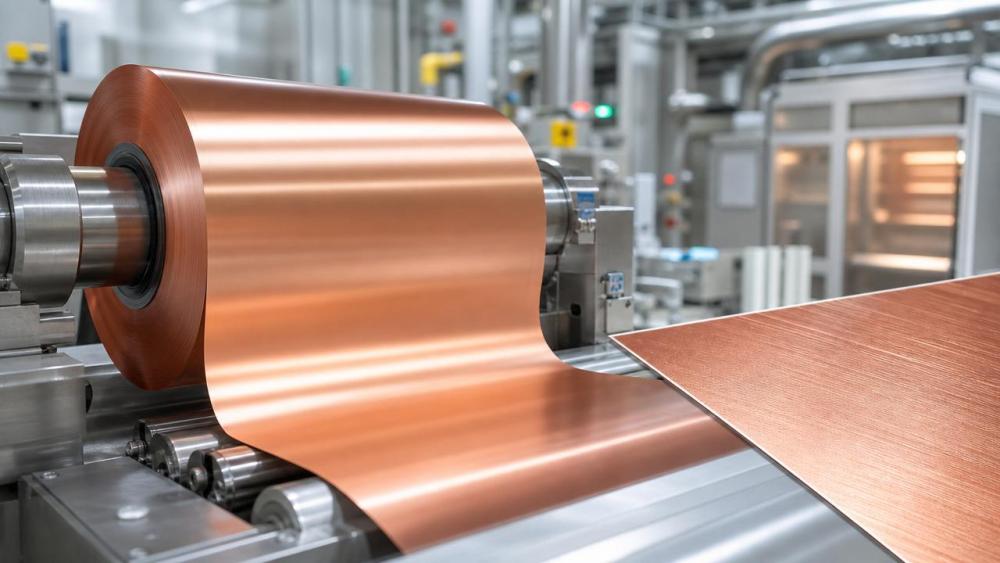
According to GGII’s latest data, the ex-factory price of 4.5 μm lithium battery copper foil increased by RMB 3,000 per ton in April 2026 versus March 2026. The rise is attributed to two concurrent supply-side factors: (1) leading producers shifting capacity from lithium battery copper foil to higher-margin PCB copper foil; and (2) surging demand for high-voltage low-profile (HVLP) copper foil driven by AI server applications. As a result, the cost of negative current collectors in liquid-cooled battery energy storage systems (BESS) rose approximately 1.2%, with implications expected to affect export pricing structures starting in Q3 2026.
Impact on Specific Subsectors
Direct Trade Enterprises
These firms face compressed margins on standard lithium battery copper foil contracts due to upward pressure on input costs, while also encountering tighter availability of 4.5 μm grade material. Impact manifests as reduced order fill rates for thin-film specifications and increased lead time volatility for export shipments destined for BESS OEMs in Europe and North America.
Raw Material Procurement Entities
Purchasers of copper foil — especially those sourcing for liquid-cooled BESS negative electrode assemblies — are experiencing cost pass-through earlier than anticipated. The 1.2% increase in negative current collector cost directly affects bill-of-materials (BOM) calculations for thermal-managed storage systems, particularly where tight cost ceilings apply (e.g., utility-scale tender bids).
Manufacturing & Assembly Firms (BESS Integrators)
Firms assembling liquid-cooled BESS units must now reassess landed cost models ahead of Q3 2026. Since 4.5 μm foil enables higher energy density and improved thermal interface in compact cell stacks, substitution with thicker alternatives risks compromising design specs — limiting viable cost-mitigation options without engineering revalidation.
Supply Chain Service Providers
Logistics and customs advisory services supporting cross-border copper foil trade are observing heightened scrutiny on origin documentation and HS code classification (e.g., distinguishing between PCB-grade and battery-grade foil), especially for shipments into markets applying anti-dumping or safeguard measures on base metal foils.
Key Points for Enterprises and Practitioners to Monitor and Act On
Track official capacity reallocation announcements from top-tier copper foil producers
Current shifts toward PCB foil are cited as a driver, but no public production plan updates have been issued beyond Q2 2026. Monitoring quarterly earnings calls and capital expenditure disclosures will clarify whether this is a tactical adjustment or structural pivot.
Monitor HVLP foil demand signals from AI server ODMs and cloud infrastructure vendors
The AI-driven HVLP demand surge is a newly emerging factor — not yet reflected in long-term supply contracts. Enterprises should assess whether their procurement agreements include index-based pricing clauses tied to HVLP-specific benchmarks or copper premium indices.
Prepare for Q3 export pricing recalibration in liquid-cooled BESS tenders
Given the 1.2% cost impact on negative current collectors, firms submitting bids for overseas BESS projects scheduled for award in July–September 2026 should adjust unit cost assumptions accordingly — particularly where fixed-price contracts dominate (e.g., EU grid-support tenders).
Review technical substitution feasibility for non-critical BESS modules
While 4.5 μm foil remains essential for high-density cell formats, analysis shows some stationary BESS applications using prismatic or LFP pouch cells may tolerate 6 μm foil without significant performance loss. Engineering teams should prioritize validation testing on lower-risk product lines before committing to full-spec sourcing.
Editorial Perspective / Industry Observation
Observably, this price movement is less an isolated commodity fluctuation and more a structural signal — reflecting tightening specialization at the intersection of battery materials and AI hardware infrastructure. Analysis shows the convergence of capacity reallocation and HVLP demand has accelerated inventory drawdown in the 4.5 μm segment faster than typical seasonal patterns, suggesting limited near-term elasticity on the supply side. From an industry perspective, the Q3 export pricing impact confirms this is transitioning from a market sentiment indicator to an operational constraint — particularly for BESS exporters operating on narrow gross margin bands. Current more appropriate interpretation is that it marks the onset of a multi-quarter supply-demand rebalancing phase, rather than a short-term price spike.
Conclusion: This development signifies a tangible shift in cost dynamics for a critical enabler of next-generation energy storage and AI hardware. It does not indicate broad-based copper foil inflation, but rather reflects intensifying competition for specialized thin-film capacity across diverging end-use segments. Stakeholders are advised to treat this as an early-stage supply chain recalibration event — one requiring targeted technical, commercial, and procurement responses rather than wholesale strategic revision.
Source: GGII (GaoGong Intelligent Automotive & Energy Research Institute), May 2026 data release.
Note: Ongoing observation is recommended regarding announced capacity shifts by Tier-1 copper foil producers — no formal production schedule revisions have been publicly confirmed as of May 15, 2026.
Related News
 Battery Container Safety Systems: Top Failure Risks and FixesGrid Storage ArchitectEnergy storage safety systems for battery containers: uncover top failure risks, from thermal imbalance to detection gaps, and learn practical fixes to improve uptime, compliance, and grid reliability.
 Battery Cooling Systems for BESS: What Causes Thermal FailuresGrid Storage ArchitectBattery cooling systems for BESS: learn what causes thermal failures, spot early warning signs, and apply practical fixes to reduce risk, improve safety, and protect grid-scale storage performance.
 EU Tightens Thermal Runaway Tests for Liquid-Cooled BESSGrid Storage ArchitectEU tightens thermal runaway tests for liquid-cooled BESS under EN IEC 62933-5-2:2026. See how UL 9540A-aligned compliance affects CE marking, customs clearance, and EU market access.
 EU Sets Binding Safety Rules for Liquid-Cooled BESSGrid Storage ArchitectEU binding safety rules for liquid-cooled BESS now make UL 9540A testing and <2°C cell monitoring essential for EU market entry. See who is affected and how to prepare before border rejections begin.
 METI Opens Fast-Track Path for Liquid-Cooled BESS ImportsGrid Storage ArchitectMETI opens a fast-track path for liquid-cooled BESS imports in Japan, offering 72-hour customs clearance and local testing exemption for JIS-compliant units through Dec 2026.
 Grid-Scale Battery Storage Power Rating: How to Avoid Oversizing and Revenue LossGrid Storage ArchitectGrid-scale battery storage power rating explained: learn how to avoid oversizing, improve utilization, and protect project revenue with scenario-first sizing strategies.
 40ft Grid Scale Battery Systems: When Does the Container Format Make Sense?Grid Storage Architect40ft grid scale battery systems: learn when the container format delivers real value in utility-scale storage, and when logistics, thermal design, safety, or maintenance make other options smarter.
 Singapore Tightens BESS Thermal Certification by 2027Grid Storage ArchitectSingapore Tightens BESS Thermal Certification by 2027: learn how EMA’s UL 9540A pre-entry rule and 1.5°C thermal threshold will impact BESS suppliers, buyers, and delivery planning.
 IEC 62933-5-2:2026 Sets New Export Test BarGrid Storage ArchitectIEC 62933-5-2:2026 sets a new compliance bar for liquid-cooled BESS exports, making thermal runaway blocking mandatory. See how it may affect certification, delivery timelines, and market access.
 Battery Cooling System Failures: Early Warning Signs and Practical FixesGrid Storage ArchitectBattery cooling system failures often begin with subtle warning signs. Learn how to spot thermal drift early, diagnose root causes, and apply practical fixes before downtime grows.
 Hithium Unveils 6.9MWh Long-Duration Liquid-Cooled BESSGrid Storage ArchitectHithium Unveils 6.9MWh Long-Duration Liquid-Cooled BESS for Europe, highlighting native 8-hour storage, 1300Ah cells, certifications, and faster localized deployment.
 Sunwoda’s UL 9540A Pass Speeds EU BESS ComplianceGrid Storage ArchitectSunwoda’s UL 9540A pass speeds EU BESS compliance, highlighting faster approvals, lower importer risk, and stronger procurement confidence for Europe’s energy storage market.