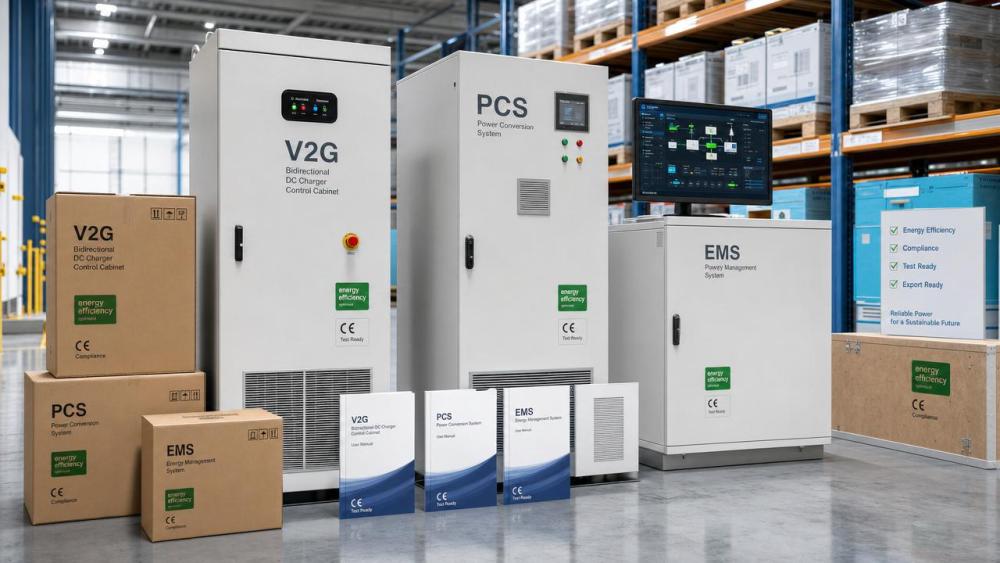
On June 9, 2026, the U.S. Federal Trade Commission updated its Appliance Labeling Rule, 16 CFR Part 305, and for the first time brought energy storage control equipment such as V2G bidirectional charging and discharging controllers, PCS, and EMS into mandatory energy labeling. For manufacturers, exporters, certification-related service providers, procurement teams, and delivery management functions, the immediate point of attention is not only the new disclosure item itself, but also the short transition window before enforcement and the need to align packaging, manuals, testing references, and compliance documentation.
What the rule now requires
According to the information provided, the FTC updated the Appliance Labeling Rule on June 9, 2026. The update extends mandatory labeling to energy storage control equipment, including V2G bidirectional charging and discharging controllers, PCS, and EMS.
The new requirement states that product packaging and product manuals must display annual grid electricity consumption, expressed as kWh/yr. The testing basis identified in the provided information is the latest version of UL 1741 SA Annex G.
The rule is scheduled to take effect on October 1, 2026. The transition period stated in the provided information is three months.
Where the practical pressure is likely to appear
For equipment makers and product integrators
From an industry perspective, this change is likely to affect product definition, label content control, and document release processes. Companies placing V2G chargers, PCS, EMS, or related control products on the market may need to verify whether existing packaging and manuals already contain the required annual electricity consumption disclosure and whether internal test references match the latest UL 1741 SA Annex G basis named in the rule.
The pressure point is not limited to design compliance. It may also extend to version management for packaging, multilingual manuals, product literature, and shipment-ready inventory that was prepared under earlier labeling assumptions.
For exporters, import-facing teams, and channel operations
Analysis shows that companies involved in cross-border sales and market entry preparation may need to review whether product documentation delivered to customers, distributors, or project partners remains consistent with the new FTC labeling requirement. Where packaging, manuals, or technical submittals are part of order fulfillment, the rule change may create a need for faster document turnover before the October 1, 2026 implementation date.
What deserves closer attention is the operational interface between compliance and shipment. If a product falls within the newly covered scope, labeling readiness may become part of delivery checks, distributor onboarding, or import documentation review, even where the product itself has already completed other technical or commercial steps.
For testing, certification, and specification support functions
Observably, the reference to the latest UL 1741 SA Annex G makes test alignment a practical issue for laboratories, certification support providers, and in-house compliance teams. Their role may shift from general product qualification support to more specific verification of the annual grid electricity consumption figure that must appear on packaging and manuals.
This also matters for teams supporting tenders, technical submissions, and customer qualification packages. If customers begin requesting consistency across labels, manuals, and test-backed declarations, documentation control may become as important as the test result itself.
What companies should review now
Check scope and product mapping first
Analysis shows that one of the first practical tasks is to identify which products in the portfolio fall within the newly covered categories described in the provided information. For companies with mixed lines across charging, storage, and control equipment, scope confirmation is likely to be the starting point for any compliance timetable.
Align labels, manuals, and test references
What deserves closer attention is whether packaging text, instruction manuals, and supporting technical files can all reflect the required annual grid electricity consumption value in a consistent way. Where internal templates or externally printed materials are already locked for near-term deliveries, companies may need to review revision cycles carefully.
Review delivery timing against the short transition period
From an industry perspective, the three-month transition period is a notable execution detail. Companies handling production scheduling, procurement coordination, and outbound shipments may need to assess whether goods prepared before the effective date can still be delivered under existing materials or whether updated labeling and document sets must be introduced earlier in the order cycle.
Track how the requirement appears in customer documents
Observably, the rule itself is one layer of compliance, but downstream execution may also depend on how procurement specifications, bid documents, and supplier qualification files begin to reference the new labeling item. The provided information does not define those downstream practices, so this remains an area to monitor rather than a settled outcome.
Why this looks like an execution signal
Analysis shows that this development is better understood as a concrete compliance expansion rather than a general policy discussion. The rule names product categories, introduces a specific disclosure item, identifies a test basis, and includes an effective date with a short transition period. That combination gives market participants a direct execution signal.
At the same time, it is also more appropriate to understand this as a rule change that still requires close observation in practice. The provided information confirms the formal requirement, but it does not describe future enforcement interpretations, customer-side implementation habits, or how widely the new disclosure will be incorporated into commercial and technical review workflows.
How to read the change at this stage
In summary, the FTC update points to a clearer compliance expectation for energy storage control equipment, especially V2G-related products that now need annual grid electricity consumption disclosure on packaging and manuals. The immediate significance lies in document control, test alignment, and delivery readiness within a limited transition period.
A neutral reading of the event is that it should currently be treated as an implemented rule change with practical compliance consequences, while the market still needs to watch how certification practice, procurement language, and execution standards develop around it.
Basis of this article
This article is generated from the user-provided news title, event date, and event summary. Typical source types relevant to this kind of development may include official regulatory notices, releases by supervisory agencies, information from trade or customs authorities, industry association updates, standards organization documents, and reporting by established professional media.
No specific official source link was provided in the input, so the exact official publication path still requires further verification. Observably, the areas that remain worth tracking include detailed implementation language, certification and testing interpretation, changes in tender or procurement documents, industry feedback, and how companies apply the requirement in actual delivery and compliance workflows.
Related News
 EV Charging Protocol References That Matter for System CompatibilityEV Infrastructure ExpertEV charging protocol references explained for real system compatibility. Learn how CCS, ISO 15118, DIN 70121, OCPP, and grid standards reduce integration risk and support scalable EV charging.
 Germany Tightens EMC Limits for V2G ChargersEV Infrastructure ExpertGermany tightens EMC limits for V2G chargers from October 2026. Learn who is affected, key compliance risks, retesting deadlines, and how to protect market access in Germany.
 Japan METI Speeds V2G Charger CertificationEV Infrastructure ExpertJapan METI speeds V2G charger certification with a fast-track route under JIS C 8702-2:2026, helping EV fleets, energy retailers, and suppliers enter Japan’s VPP pilot zones faster.
 Japan Speeds JIS Track for V2G ChargersEV Infrastructure ExpertJapan speeds JIS track for V2G chargers, cutting approval from 14 weeks to 6. Learn how JIS C 8201-7-1, sub-100ms response, and ISO 15118-20 reshape market entry.
 Japan Opens Faster V2G Charger CertificationEV Infrastructure ExpertJapan opens faster V2G charger certification with METI’s new 6-week path. See how JIS C 8201-7-1 compliance, firmware resilience, and grid-response logging impact market access.
 Japan Tightens V2G Charger Grid Entry RulesEV Infrastructure ExpertJapan Tightens V2G Charger Grid Entry Rules: learn how Japan’s new V2G bidirectional charger compliance, JET certification, and IEEE 1547-2024 Rev.2 rules may impact launch timing and market access.
 Vehicle to Grid System Basics: Benefits, Limits, and Real Use CasesEV Infrastructure ExpertVehicle to grid system basics made clear: explore key benefits, real limits, and practical use cases for fleets, homes, and grid support before you invest.
 CBP Clarifies HTS Code for V2G ChargersEV Infrastructure ExpertCBP clarifies the HTS code for V2G chargers, shifting qualifying models to HTS 8504.40.95 with a 3.7% tariff and DOE cybersecurity certification. See who is affected and what to review now.
 DOE Extends Cybersecurity Mandate to V2G ChargersEV Infrastructure ExpertDOE extends cybersecurity rules for V2G chargers, requiring NIST SP 800-207A and UL 1998 compliance by Aug. 31, 2026. See how this impacts procurement, IRA tax credits, and U.S. market access.
 DOE V2G Vendor List Adds 7 Chinese PCS FirmsEV Infrastructure ExpertDOE V2G Vendor List adds 7 Chinese PCS firms, reshaping U.S. utility and municipal EV tenders. See what it means for certification, bidding, compliance, and project delivery.
 DOE Opens Fast-Track for V2G ChargersEV Infrastructure ExpertDOE opens a fast-track for V2G chargers, cutting federal procurement to 9 working days. See how certification, approved vendors, and 3-year service support could reshape U.S. market access.
 FERC Rule Takes Effect for VPP-Connected V2G DevicesEV Infrastructure ExpertFERC Rule takes effect for VPP-connected V2G devices, making UL 1998, IEC 62443-4-2, and firmware hash-chain compliance critical for market settlement. See who is affected now.