For financial approvers, V2G technology is no longer a futuristic grid concept—it is an asset-utilization decision with measurable payback, risk exposure, and battery-life implications. As EV fleets become distributed storage resources, the core question shifts from “Can vehicles support the grid?” to “When does bidirectional charging improve total cost of ownership?” This article examines how revenue streams, degradation costs, tariff design, and operational controls shape the real investment case for V2G deployment.
In board-level discussions, the value of V2G technology must be translated into cash flow, warranty exposure, infrastructure utilization, and grid-service optionality. A technically elegant project can still fail if vehicles are unavailable during revenue windows, tariffs are misaligned, or battery wear is underestimated.
For ESGS readers evaluating charging depots, swapping hubs, BESS containers, and virtual power plant integration, the financial lens is essential. V2G technology sits between mobility operations and grid dispatch, so approval should combine fleet economics with power-market discipline.
Where V2G Technology Creates Financial Value
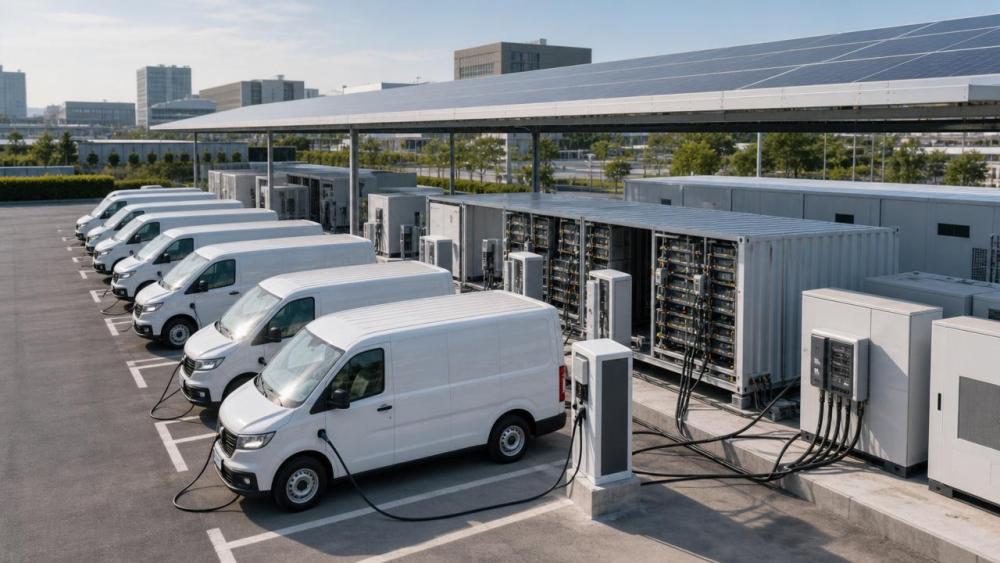
V2G technology allows an electric vehicle battery to discharge electricity back to a building, depot, microgrid, or utility network through a bidirectional charger. The commercial value comes from using idle battery capacity during defined market or tariff windows.
For many fleets, vehicles are parked for 8–14 hours per day. Even if only 15%–35% of aggregate battery capacity is available, that idle time can become a dispatchable asset when controlled by a VPP platform.
Core Revenue Streams for Approval Models
Financial approvers should avoid treating V2G technology as a single-income investment. The strongest projects usually stack 2–4 revenue streams, while reserving enough state of charge for route reliability and emergency mobility needs.
- Peak shaving: discharging during expensive 1–4 hour demand peaks to reduce facility demand charges.
- Time-of-use arbitrage: charging during low-price periods and exporting or self-consuming during high-price periods.
- Frequency regulation: providing fast-response power services, often requiring second-level or sub-second control signals.
- Backup and resilience: supporting critical loads for depots, warehouses, telecom sites, or emergency service bases.
- Capacity participation: aggregating EVs with stationary BESS containers to meet grid or utility capacity requirements.
The practical question is not whether every market is available. It is whether local tariffs, interconnection rules, metering, charger certification, and aggregator contracts permit bankable cash flows over 3–7 years.
Typical Business Cases by Fleet Type
The payback profile of V2G technology varies sharply by vehicle duty cycle. A school bus fleet parked midday and overnight behaves differently from a logistics fleet that operates two shifts.
The table shows why a single payback assumption is risky. V2G technology performs best when the fleet schedule, grid price signal, and control platform are aligned before procurement approval.
Payback Calculation: What Finance Teams Should Measure
A credible V2G technology business case begins with incremental cost. Finance teams should separate the base EV charging requirement from the additional cost of bidirectional hardware, software, metering, interconnection, and lifecycle support.
In many projects, simple payback may range from 3 to 8 years, depending on charger cost, utilization rate, tariff spread, battery degradation allocation, and revenue certainty. Sensitivity analysis matters more than a single headline number.
The Approval Formula
At a minimum, approvers should model annual gross benefit, annual degradation cost, operational expense, and residual value impact. The investment only improves TCO when net value exceeds the added capital and risk-adjusted operating burden.
- Define available battery capacity after route reserve, commonly 20%–60% of nameplate capacity.
- Estimate export windows, usually 1–3 events per day or market-specific dispatch intervals.
- Calculate gross revenue from avoided demand charges, energy spread, or ancillary service payments.
- Deduct battery degradation, charger maintenance, software fees, metering fees, and settlement costs.
- Stress-test payback under low, base, and high utilization scenarios across 36–84 months.
Key Input Ranges
A disciplined approval model for V2G technology should use transparent ranges rather than optimistic fixed values. For example, charger power may run from 7 kW for light vehicles to 60 kW or higher for depot-scale DC systems.
These ranges help prevent overapproval. If a project only works at maximum export hours, minimum battery wear, and perfect market access, the investment should be redesigned before funds are committed.
Battery Impact: Degradation Is a Cost, Not a Deal Breaker
Battery impact is the most common objection to V2G technology, and it deserves serious treatment. Degradation is affected by cycle depth, temperature, charging rate, average state of charge, chemistry, and battery management rules.
The financial mistake is to ignore degradation or to assume every discharge is harmful in the same way. Shallow cycling between controlled state-of-charge bands can be materially different from deep cycling at high temperatures.
How to Price Battery Wear
Approvers should require a degradation reserve in the V2G technology model. This can be expressed as a cost per kWh discharged, a warranty risk allowance, or a residual value adjustment at vehicle resale.
- Use conservative cycle assumptions, such as 0.1–0.5 equivalent full cycles per active day.
- Limit discharge depth, often keeping operations within a 20%–80% state-of-charge window.
- Track battery temperature and avoid high-power discharge during thermal stress events.
- Confirm whether OEM warranties allow bidirectional operation and under what metering conditions.
- Separate mobility cycles from grid-service cycles for auditable lifecycle accounting.
Thermal Management and Control Discipline
The ESGS view is that V2G technology should be evaluated alongside advanced battery thermodynamic management. The same discipline used in grid-scale BESS containers applies to EV fleets participating in grid services.
For high-duty projects, battery temperature consistency, charger cooling, PCS conversion efficiency, and millisecond-level dispatch response can decide whether revenue is profitable or consumed by accelerated maintenance.
A practical safeguard is to set operational constraints before market bidding. These include daily energy caps, maximum discharge power, temperature lockout thresholds, and route-priority override rules.
Procurement Criteria for Bankable V2G Deployment
Buying V2G technology is not the same as buying standard EV chargers. The procurement package must integrate bidirectional chargers, vehicle compatibility, site electrical design, market settlement, cybersecurity, and maintenance responsibilities.
For depots above 500 kW of connected charging load, a poor design can trigger transformer upgrades, switchgear changes, or utility interconnection delays lasting 3–12 months. Early grid studies reduce approval uncertainty.
Six Approval Questions Before Purchase
- Which vehicles, battery chemistries, and OEM warranty terms explicitly support bidirectional operation?
- Does the site have sufficient transformer capacity, protection coordination, and metering architecture?
- What revenue streams are contractually available, and what minimum performance obligations apply?
- Can the control platform coordinate chargers, stationary BESS, solar PV, and building loads?
- How are cybersecurity, remote firmware updates, and data ownership handled over 5 years?
- Who carries liability for missed dispatch, battery warranty disputes, and interconnection non-compliance?
Integration With BESS, UHV, and Smart Grid Assets
V2G technology becomes more valuable when connected to a wider energy architecture. A depot may combine rooftop PV, a 1–5 MWh BESS container, bidirectional chargers, and digital dispatch software.
At grid scale, EV fleets are small storage nodes compared with UHV transmission or utility batteries. Yet they are fast, distributed, and located near demand, which makes them useful for congestion relief and local flexibility.
For mega charging and swapping infrastructure, V2G technology can reduce peak import, improve transformer utilization, and support ancillary services. The strongest configuration is often a hybrid system rather than EV batteries alone.
Implementation Roadmap and Risk Controls
A staged rollout is safer than a fleet-wide conversion. Financial approvers should ask for a pilot that validates vehicle availability, market participation, charger uptime, and actual battery behavior over at least 90–180 days.
The implementation plan should convert operational assumptions into evidence. Without measured idle time, route reserve requirements, and dispatch acceptance rates, V2G technology remains a spreadsheet rather than an investable asset.
A Practical 5-Step Rollout
- Baseline analysis: collect 30–60 days of vehicle dwell time, energy use, and site load data.
- Technical screening: confirm charger standards, protection design, interconnection process, and OEM permissions.
- Pilot deployment: start with 5–20 vehicles or a limited number of bidirectional ports.
- Performance validation: compare forecast and actual revenue, cycling, availability, and uptime.
- Scaled procurement: expand only after tariff value, degradation controls, and operating procedures are proven.
Common Mistakes That Damage Payback
The first mistake is ignoring vehicle availability. A fleet with high mileage variability may need a larger reserve, reducing usable capacity by 20%–40% compared with theoretical calculations.
The second mistake is underestimating soft costs. Interconnection studies, communications gateways, settlement systems, operator training, and preventive maintenance can materially affect payback, especially in smaller deployments.
The third mistake is treating V2G technology as a standalone charger purchase. Financially strong projects define dispatch rules, maintenance duties, tariff participation, and battery reporting before hardware orders are issued.
When V2G Technology Deserves Budget Approval
V2G technology deserves approval when it improves fleet TCO under conservative assumptions, not just under ideal dispatch conditions. The strongest candidates have predictable parking windows, high demand charges, supportive tariffs, and warranty clarity.
For financial approvers, the decision should be framed around 4 measurable tests: net annual value, operational reliability, battery risk control, and scalability into a wider energy system.
Decision Guidance for Finance and Procurement Teams
Approve a pilot when the project can demonstrate a realistic path to cash flow within 12–24 months. Delay approval when revenue depends on unavailable markets, uncertain interconnection, or unsupported vehicle warranties.
Scale deployment when measured performance confirms charger uptime, dispatch acceptance, thermal stability, and driver satisfaction. Combine V2G technology with stationary BESS where peak power requirements exceed vehicle availability.
ESGS helps decision makers connect bidirectional charging economics with grid-scale storage, smart T&D equipment, and VPP dispatch logic. This broader view reduces stranded investments and improves asset utilization.
V2G technology is not automatically profitable, but it can be highly valuable when governed by disciplined financial modeling and operational controls. Payback depends on stacked revenues, battery-aware dispatch, tariff access, and integration quality.
If your organization is evaluating V2G technology for EV fleets, charging depots, swapping stations, or hybrid BESS projects, ESGS can support the commercial and technical assessment. Contact us to obtain a tailored deployment review, compare investment scenarios, or learn more solutions for grid-flexible electrified transport.
Related News
 EV Charging Protocol References That Matter for System CompatibilityEV Infrastructure ExpertEV charging protocol references explained for real system compatibility. Learn how CCS, ISO 15118, DIN 70121, OCPP, and grid standards reduce integration risk and support scalable EV charging.
 Germany Tightens EMC Limits for V2G ChargersEV Infrastructure ExpertGermany tightens EMC limits for V2G chargers from October 2026. Learn who is affected, key compliance risks, retesting deadlines, and how to protect market access in Germany.
 Japan METI Speeds V2G Charger CertificationEV Infrastructure ExpertJapan METI speeds V2G charger certification with a fast-track route under JIS C 8702-2:2026, helping EV fleets, energy retailers, and suppliers enter Japan’s VPP pilot zones faster.
 Japan Speeds JIS Track for V2G ChargersEV Infrastructure ExpertJapan speeds JIS track for V2G chargers, cutting approval from 14 weeks to 6. Learn how JIS C 8201-7-1, sub-100ms response, and ISO 15118-20 reshape market entry.
 Japan Opens Faster V2G Charger CertificationEV Infrastructure ExpertJapan opens faster V2G charger certification with METI’s new 6-week path. See how JIS C 8201-7-1 compliance, firmware resilience, and grid-response logging impact market access.
 Japan Tightens V2G Charger Grid Entry RulesEV Infrastructure ExpertJapan Tightens V2G Charger Grid Entry Rules: learn how Japan’s new V2G bidirectional charger compliance, JET certification, and IEEE 1547-2024 Rev.2 rules may impact launch timing and market access.
 Vehicle to Grid System Basics: Benefits, Limits, and Real Use CasesEV Infrastructure ExpertVehicle to grid system basics made clear: explore key benefits, real limits, and practical use cases for fleets, homes, and grid support before you invest.
 CBP Clarifies HTS Code for V2G ChargersEV Infrastructure ExpertCBP clarifies the HTS code for V2G chargers, shifting qualifying models to HTS 8504.40.95 with a 3.7% tariff and DOE cybersecurity certification. See who is affected and what to review now.
 DOE Extends Cybersecurity Mandate to V2G ChargersEV Infrastructure ExpertDOE extends cybersecurity rules for V2G chargers, requiring NIST SP 800-207A and UL 1998 compliance by Aug. 31, 2026. See how this impacts procurement, IRA tax credits, and U.S. market access.
 DOE V2G Vendor List Adds 7 Chinese PCS FirmsEV Infrastructure ExpertDOE V2G Vendor List adds 7 Chinese PCS firms, reshaping U.S. utility and municipal EV tenders. See what it means for certification, bidding, compliance, and project delivery.
 DOE Opens Fast-Track for V2G ChargersEV Infrastructure ExpertDOE opens a fast-track for V2G chargers, cutting federal procurement to 9 working days. See how certification, approved vendors, and 3-year service support could reshape U.S. market access.
 FERC Rule Takes Effect for VPP-Connected V2G DevicesEV Infrastructure ExpertFERC Rule takes effect for VPP-connected V2G devices, making UL 1998, IEC 62443-4-2, and firmware hash-chain compliance critical for market settlement. See who is affected now.