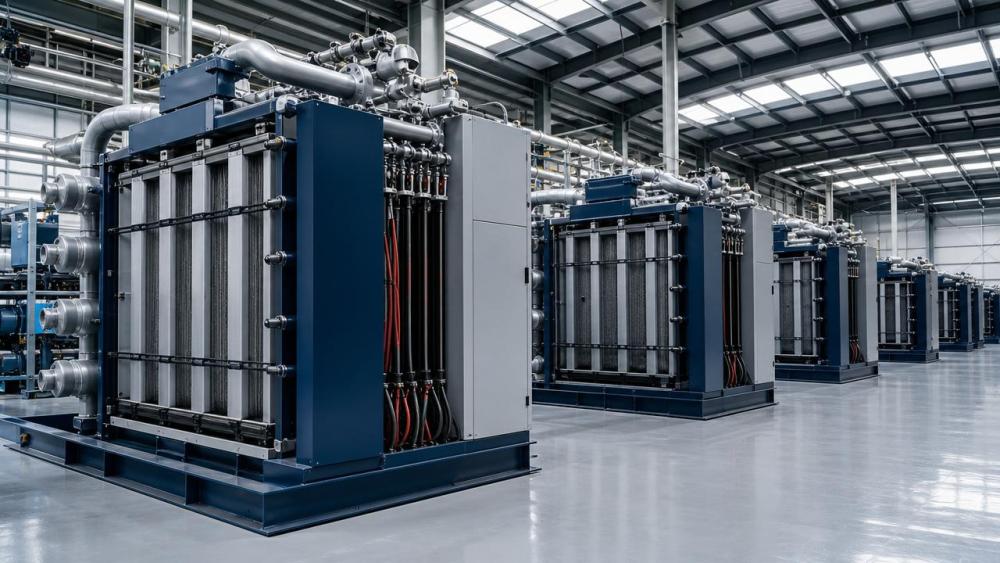
On May 28, 2026, NEOM — Saudi Arabia’s flagship giga-project — initiated the tender for the world’s largest alkaline (ALK) water electrolysis system, totaling 12 GWh. The procurement mandates a minimum local content rate of 40% for the complete ALK system — including core electrolyzer stacks, power management units, and control systems — and requires verification of operational resilience under variable green electricity input. This development signals material implications for global electrolyzer manufacturers, engineering contractors, and supply chain stakeholders engaged in hydrogen infrastructure deployment, particularly those active in or targeting the Middle East clean energy market.
Event Overview
On May 28, 2026, NEOM officially launched an international tender for a 12 GWh alkaline (ALK) electrolyzer system. The tender specifies a minimum local content requirement of 40% across the full ALK system — explicitly covering core electrolyzer stacks, power management and control systems. Bidders must demonstrate technical compliance with green power fluctuation tolerance testing. Joint ventures — including foreign ALK equipment suppliers and Middle Eastern engineering firms — are explicitly permitted.
Industries Affected by This Tender
ALK Electrolyzer Manufacturers (OEMs)
Manufacturers producing ALK electrolyzers face direct commercial opportunity but also new localization constraints. The 40% local content rule means OEMs cannot supply fully imported systems; instead, they must either establish local assembly, partner with regional entities, or co-develop localized subsystems. Impact manifests in revised business models, extended lead times for local certification, and increased coordination overhead with Saudi partners.
Engineering, Procurement & Construction (EPC) Contractors in the GCC
GCC-based EPC firms are positioned as essential enablers for foreign OEMs seeking to meet the local content threshold. Their role shifts from pure project execution to strategic integration partners — responsible for local manufacturing oversight, regulatory interface, and grid-integration validation. Demand for EPCs with proven experience in hydrogen plant commissioning and green power interface testing is likely to rise.
Power Electronics & Control System Suppliers
Suppliers of power conversion units (e.g., rectifiers, inverters), PLCs, SCADA platforms, and dynamic load-balancing software are affected because the tender explicitly includes these components within the 40% local content scope. This implies that even non-electrolyzer hardware must be locally sourced, assembled, or certified — expanding localization pressure beyond core stack manufacturing.
Supply Chain & Localization Support Services
Third-party service providers offering localization advisory, Saudi Industrial Development Fund (SIDF) alignment support, NIDLP (National Industrial Development and Logistics Program) compliance guidance, and local vendor qualification assistance may see increased engagement. The tender’s strict local content definition creates demand for structured support in mapping, qualifying, and auditing domestic Tier-2/Tier-3 suppliers.
What Relevant Companies or Practitioners Should Monitor and Do Now
Track official tender documentation and clarification timelines
The current announcement confirms launch date and high-level requirements, but full technical specifications, evaluation criteria, and submission deadlines remain pending. Companies should formally register interest with NEOM’s procurement portal and monitor updates closely — especially any revisions to the definition of ‘local content’ or acceptable verification protocols for green power fluctuation testing.
Assess eligibility for joint venture formation with pre-qualified GCC EPC firms
Since joint bids are permitted and local content must cover both hardware and system integration, identifying and engaging qualified Saudi or UAE-based EPC partners — particularly those with prior NEOM or PIF-affiliated project exposure — is operationally urgent. Due diligence should focus on their capacity for local manufacturing oversight and regulatory liaison, not just construction capability.
Distinguish between policy intent and executable scope
While the 40% local content target is stated, it remains unclear whether this applies to value-add, employment, or physical assembly — or a combination. Analysis shows that NEOM’s previous tenders have emphasized traceable domestic value creation (e.g., labor, engineering hours, final assembly), rather than simple component sourcing. Companies should avoid assuming ‘localization = local procurement’ without reviewing formal definitions.
Prepare technical documentation for green power fluctuation validation
The requirement to verify tolerance under variable renewable input is non-standard in many existing ALK certifications. Current more suitable preparation includes compiling existing test reports from wind/solar-coupled pilot deployments, documenting control logic for ramp-rate adaptation, and aligning with IEC 62282-9-100 or equivalent draft standards. Third-party validation labs accredited in Saudi Arabia or the GCC should be contacted early.
Editorial Perspective / Industry Observation
Observably, this tender functions primarily as a policy signal — not yet a commercial award. Its significance lies less in immediate revenue and more in its role as a benchmark for future hydrogen infrastructure procurement across the Gulf Cooperation Council (GCC). From an industry perspective, NEOM is institutionalizing two critical expectations: first, that large-scale green hydrogen projects must embed domestic industrial participation at the system level; second, that equipment must be validated under real-world intermittent generation conditions — moving beyond steady-state lab certification. Analysis suggests this reflects a broader shift toward performance-based, context-aware procurement in national hydrogen strategies. It is not yet a de facto standard, but it sets a precedent others may follow.
This tender does not represent a finalized contract or confirmed project timeline. Rather, it marks the formal commencement of competitive procurement for a single — albeit strategically significant — ALK electrolyzer package within NEOM’s broader hydrogen roadmap. Its primary function is to define technical, commercial, and localization parameters for bidders, while signaling NEOM’s prioritization of sovereign capability building alongside decarbonization goals.
Conclusion
This tender is best understood not as an isolated procurement event, but as a structural inflection point for how green hydrogen equipment is sourced and deployed in sovereign-led energy transitions. For industry participants, it underscores that localization is no longer optional for major Gulf hydrogen projects — and that technical compliance now extends beyond efficiency metrics to include dynamic grid interaction. A measured, documentation-driven, and partnership-first response remains more appropriate than rapid bidding without due diligence.
Source Attribution
Main source: Official NEOM procurement announcement dated May 28, 2026.
Points requiring ongoing observation: Final tender documents (technical specifications, evaluation methodology, local content verification framework), bid submission deadline, and subsequent bidder shortlisting announcements.
Related News
 Grid Interconnection Delays: 5 Design Issues That Slow ApprovalSmart Grid StrategistGrid interconnection delays often start with avoidable design gaps. Discover 5 issues that slow approval and how to cut review cycles, reduce risk, and accelerate project connection.
 Energy Transition Technologies: Which Options Scale Safely in 2026?Mr. Orion SterlingEnergy transition technologies in 2026: discover which options scale safely across BESS, UHV, EV charging, and hydrogen—and what to verify before investing.
 Clean Energy Integration Risks: Grid Code Gaps to Check EarlyDr. Valeria ThorneClean energy integration starts failing before commissioning when grid code gaps go unchecked. Learn the early risks, costly failure points, and smart review steps to protect project timelines.
 Distributed Storage for C&I Sites: What Impacts Payback Most?Grid Storage ArchitectDistributed storage payback at C&I sites depends more on tariffs, demand charges, load profile, and dispatch than battery cost. See what really drives faster ROI.
 Battery Swapping Stations: Cost and Uptime Trade-Offs in 2026EV Infrastructure ExpertBattery swapping stations in 2026 face a real test: balancing cost, uptime, and grid integration. Explore where swapping delivers durable value and where fast charging may win.
 IEA Sees Grid Investment at $550bn in 2026UHV Engineering FellowIEA Sees Grid Investment at $550bn in 2026, signaling rising demand for grid equipment and BESS. Explore cost pressures, delivery risks, and supply-chain opportunities.
 FlexGen and Rosendin Launch MV BESS for AI UptimeGrid Storage ArchitectFlexGen and Rosendin launch a 35kV MV BESS for AI uptime, offering diesel-free backup, millisecond black start, and 8-hour power—see why it may reshape data center resilience.
 UK DESNZ Data Signals Shift Toward Larger Battery SystemsGrid Storage ArchitectUK DESNZ data signals a shift toward larger battery systems, with lower per-kWh costs reshaping UK energy storage pricing, C&I demand, and exporter opportunities. Explore what it means now.
 World’s First Grid-Connected Sodium-Ion Storage Plant Goes LiveGrid Storage ArchitectWorld’s First Grid-Connected Sodium-Ion Storage Plant goes live in Yunnan, proving sodium-ion BESS in real grid operation. Explore its impact on long-duration storage, renewable integration, and global energy buyers.
 Turkey Ends Lithium Battery Duty ExemptionGrid Storage ArchitectTurkey Ends Lithium Battery Duty Exemption: learn how Turkey’s new tariff rule may raise energy storage import costs, complicate customs compliance, and reshape sourcing for EPCs and distributors.
![]() Energy Storage Trends 2026: Safety Risks Behind Faster DeploymentGrid Storage ArchitectEnergy storage trends in 2026 reveal the hidden safety risks behind faster BESS, EV charging, grid, and hydrogen deployment. Discover practical checks to reduce failures fast.
Energy Storage Trends 2026: Safety Risks Behind Faster DeploymentGrid Storage ArchitectEnergy storage trends in 2026 reveal the hidden safety risks behind faster BESS, EV charging, grid, and hydrogen deployment. Discover practical checks to reduce failures fast.![]() ALK Electrolyzers: Key Efficiency Losses to Check in 2026Hydrogen Tech ScientistALK electrolyzers face growing scrutiny in 2026. Discover the key efficiency losses across rectifiers, thermal control, gas purity, and auxiliaries to benchmark projects smarter.
ALK Electrolyzers: Key Efficiency Losses to Check in 2026Hydrogen Tech ScientistALK electrolyzers face growing scrutiny in 2026. Discover the key efficiency losses across rectifiers, thermal control, gas purity, and auxiliaries to benchmark projects smarter.