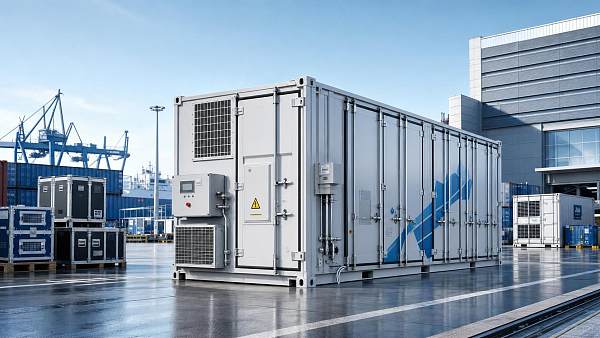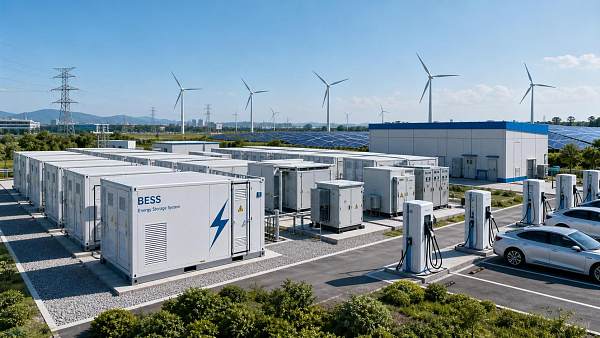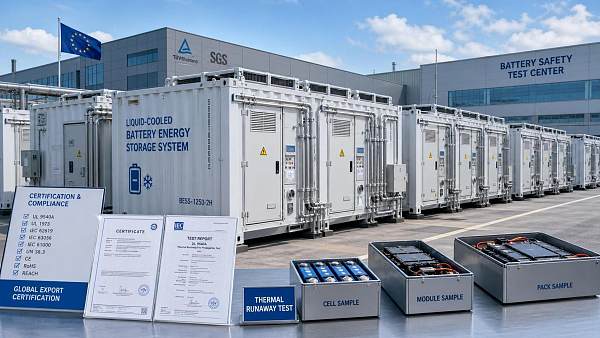
On May 30, 2026, the European Commission implemented new enforcement rules under the EU Battery Regulation, mandating that all liquid-cooled battery energy storage systems (BESS) placed on the EU market must hold both UL 9540A (thermal runaway propagation testing) and UN38.3 (transport safety testing) certifications. This requirement applies immediately to commercial, industrial, and grid-scale liquid-cooled BESS — with no transition period. Exporters, certification bodies, and supply chain stakeholders in energy storage, power electronics, and international trade should closely monitor implications for compliance timelines, documentation updates, and market access.
Event Overview
The European Commission formally enforced the detailed implementation provisions of the EU Battery Regulation on May 30, 2026. As confirmed in official publications, the regulation now requires all liquid-cooled BESS intended for the EU market to demonstrate compliance with both UL 9540A and UN38.3 standards. The requirement is effective immediately upon entry into force, and no grace or transitional period is provided. Affected products include stationary energy storage systems deployed in commercial, industrial, and utility-scale applications where liquid cooling is used as the primary thermal management method.
Impact on Specific Industry Segments
Direct Exporters & OEMs: Companies exporting liquid-cooled BESS from third countries — particularly China-based manufacturers — face immediate compliance obligations. Without valid UL 9540A and UN38.3 reports issued by EU-recognized third-party laboratories, CE Declaration of Conformity (DoC) cannot be lawfully drawn up or updated, blocking customs clearance and market placement.
Component & Subsystem Suppliers: Firms supplying critical subsystems — such as liquid-cooled battery modules, thermal management units, or integrated rack-level enclosures — may see revised procurement specifications from OEMs. Their technical documentation and test evidence may need alignment with UL 9540A boundary conditions (e.g., cell-to-cell spacing, coolant flow rate, fault injection protocols) and UN38.3 transport simulation parameters.
Certification & Testing Service Providers: Laboratories accredited for UL 9540A and UN38.3 testing are likely to experience increased demand — especially those with EU Notified Body status or mutual recognition agreements with EU authorities. Lead times for full-system testing may extend, requiring earlier engagement from clients.
Distribution & Channel Partners: EU-based importers and distributors handling liquid-cooled BESS must verify that incoming shipments are accompanied by updated DoC documents referencing both certifications. Stock held prior to May 30, 2026, does not qualify for grandfathering; resale without compliant documentation risks non-compliance penalties under EU market surveillance frameworks.
What Stakeholders Should Monitor and Act On Now
Verify current certification scope and validity
Confirm whether existing UL 9540A and UN38.3 reports cover the exact configuration, cooling architecture, and control logic of the product being placed on the EU market. Reports based on air-cooled variants or older thermal designs do not satisfy the new requirement.
Update CE Declaration of Conformity (DoC) before shipment
The DoC must explicitly reference both UL 9540A and UN38.3 test reports — including report numbers, issuing laboratory names, and dates of issue. Generic references to ‘battery safety standards’ are insufficient under the new enforcement interpretation.
Engage EU-recognized testing labs early — especially for system-level validation
UL 9540A testing at system level (e.g., full rack with BMS interaction, coolant pump failure modes) can require several weeks. UN38.3 testing adds further time due to vibration, shock, and altitude simulation cycles. Scheduling should begin well ahead of planned EU delivery dates.
Review contractual terms with EU partners for compliance liability allocation
Contracts with EU importers or project integrators should clarify responsibility for certification maintenance, DoC updates, and consequences of non-conformance — particularly where system integration occurs post-importation.
Editorial Observation / Industry Perspective
Observably, this enforcement marks a shift from general battery safety expectations to prescriptive, technology-specific conformity requirements. It is not merely a procedural update but a de facto technical barrier targeting a high-growth segment — liquid-cooled BESS — where thermal performance and transport resilience are operationally interdependent. Analysis shows the absence of a transition period signals regulatory urgency around fire safety and logistics risk mitigation in dense urban and grid-critical deployments. From an industry perspective, this is less a one-time compliance checkpoint and more a signal of tightening convergence between safety, sustainability, and supply chain traceability requirements across EU climate and digital infrastructure policies.
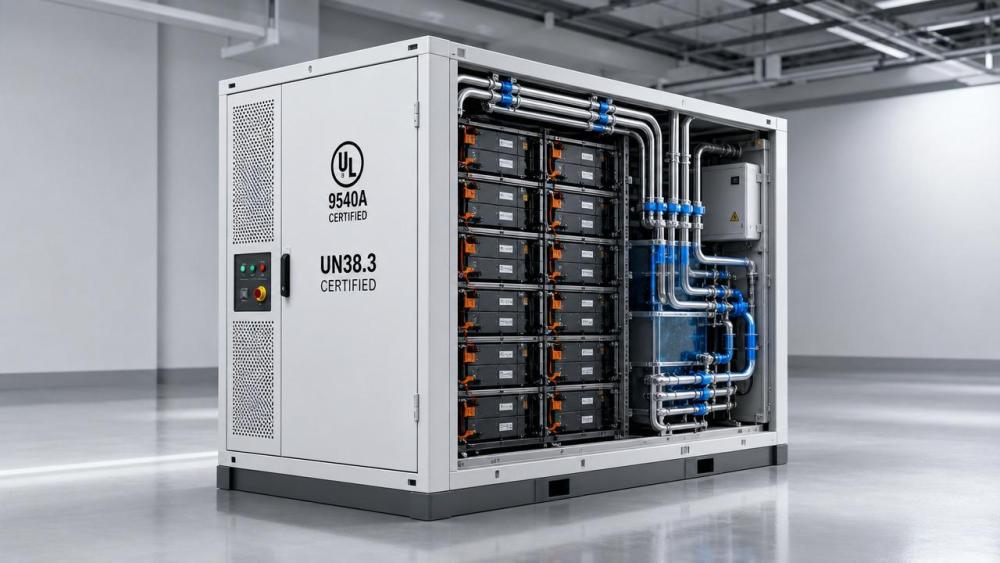
Conclusion: This measure formalizes a dual-safety benchmark for liquid-cooled BESS entering the EU — reflecting heightened scrutiny of both operational safety (UL 9540A) and logistical integrity (UN38.3). It does not introduce new standards per se, but enforces their joint application as a mandatory condition for market access. Currently, it is best understood as an enforceable operational threshold — not a provisional guideline — requiring active verification and documentation alignment by affected actors.
Source: European Commission Official Journal — Implementing Regulation (EU) 2026/XXX on the Battery Regulation (published May 30, 2026).
Further monitoring required for: (i) updates to EU Commission guidance on acceptable test report formats; (ii) potential extension of similar requirements to other cooling methods (e.g., immersion cooling) in future amendments.
Related News
 How to Evaluate a Virtual Power Plant Aggregation PlatformProf. Kaelen VossVirtual power plant aggregation platform evaluation starts with real dispatch, integration, optimization, and security checks. Learn how to compare vendors and choose a scalable, bankable solution.
 EU Sets UL 9540A Rule for Imported Liquid-Cooled BESSGrid Storage ArchitectEU sets UL 9540A rule for imported liquid-cooled BESS. Learn how the October 2026 EU requirement impacts compliance, certification timelines, costs, and delivery planning.
 Oil-Immersed Transformer Applications in Reliable Power Distribution ProjectsUHV Engineering FellowAn application guide for oil-immersed transformer buyers reviewing load profile, site conditions, insulation, cooling, testing, documentation, and project integration.
 Grid Resilience Solution Price: Cost Drivers and ROI BenchmarksMr. Orion SterlingGrid resilience solution price explained: compare cost drivers, hidden risks, and ROI benchmarks to choose a safer, higher-value energy resilience investment.
 DOE Adds UL 62271-200 for Imported ElectrolyzersHydrogen Tech ScientistDOE Adds UL 62271-200 for Imported Electrolyzers: learn how the new U.S. rule affects ALK and PEM shipments, certification timing, compliance costs, and market access from Sept. 1, 2026.
 DC Fast Charging Station Kiosk: Key Features to Compare Before You SpecifyEV Infrastructure ExpertDC fast charging station kiosk selection goes beyond power ratings. Compare uptime, thermal design, connectors, payments, and grid readiness before you specify.
 EU Sets New Thermal Runaway Test Rule for Liquid-Cooled BESSGrid Storage ArchitectEU Sets New Thermal Runaway Test Rule for Liquid-Cooled BESS: learn how UL 9540A Tier 3 and EN 50620:2025 requirements may impact EU market access, timelines, and compliance costs.
 PEM Hydrogen Electrolyzer Sizing: Key Factors That Affect Efficiency and CostHydrogen Tech ScientistPEM hydrogen electrolyzer sizing directly affects efficiency, CAPEX, and hydrogen cost. Learn the key factors shaping smarter, scalable system decisions.
 IEC 62933-5-2:2026 Makes VPP Interfaces MandatoryGrid Storage ArchitectIEC 62933-5-2:2026 makes VPP interfaces mandatory for newly certified PCS and EMS products, reshaping compliance in 32 export markets. Learn what manufacturers, integrators, and distributors must do now.
 Energy Storage Systems Integration: Common Failures and FixesGrid Storage ArchitectEnergy storage systems integration often fails at control, thermal, and commissioning interfaces. Discover common faults, practical fixes, and how to improve BESS reliability and project ROI.
 EV Charging Protocol References That Matter for System CompatibilityEV Infrastructure ExpertEV charging protocol references explained for real system compatibility. Learn how CCS, ISO 15118, DIN 70121, OCPP, and grid standards reduce integration risk and support scalable EV charging.
 C&I Storage for Factories: Where It Delivers the Best ROIGrid Storage ArchitectCommercial and industrial storage for factories delivers the best ROI when it cuts demand charges, boosts solar self-consumption, and protects uptime. See where payback is fastest.