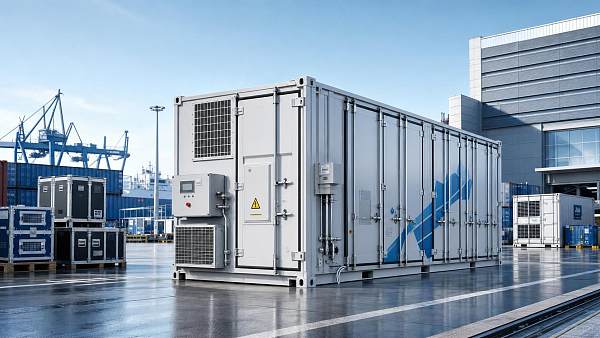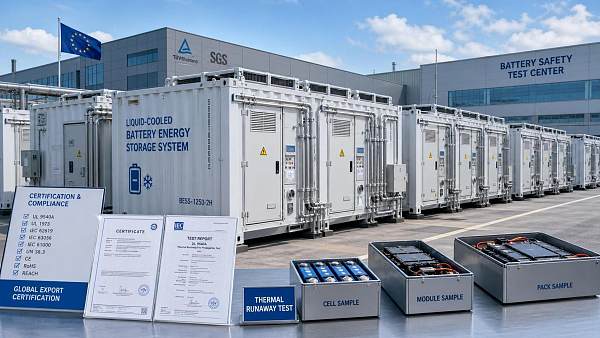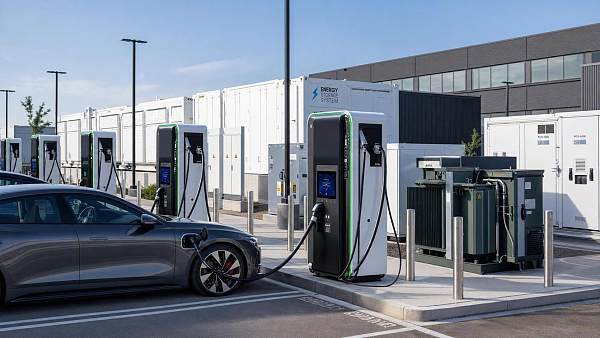
The European Commission announced the official launch of the Monitoring, Reporting, and Verification (MRV) system under Regulation (EU) 2023/1542 on 24 May 2026 — triggering a critical compliance deadline for Chinese manufacturers exporting commercial and industrial battery energy storage systems (C&I BESS) to the EU market.
Regulatory Timeline and Mandatory Requirements
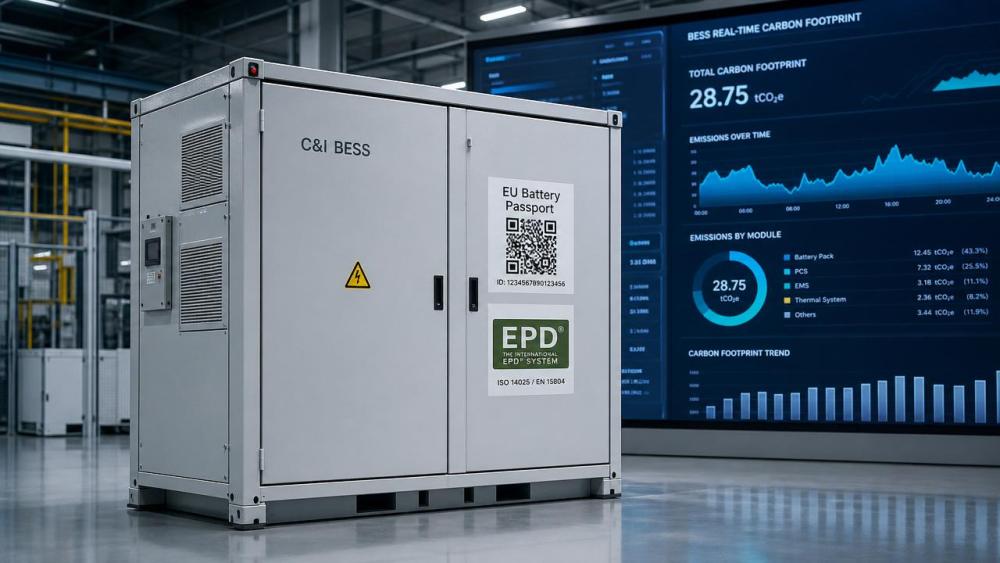
On 24 May 2026, the European Commission issued its formal notice confirming the operational readiness of the MRV system for batteries. As stipulated in Regulation (EU) 2023/1542, all C&I BESS placed on the EU market from 30 September 2026 must be supported by a verified full-life-cycle carbon footprint data chain. This includes traceable upstream emissions data, validated via an EU-recognised verification body. Additionally, Chinese exporters are required to integrate their product data into the EU’s Life Cycle Assessment (LCA) database and the mandatory digital battery passport platform.
Impact Across Supply Chain Roles
Export-oriented trading enterprises
These firms face immediate implications for customs clearance and market access: failure to submit compliant carbon footprint documentation and digital passport identifiers will result in shipment rejection or detention at EU borders. Their contractual obligations with EU buyers now require explicit carbon data deliverables and third-party verification certificates as preconditions for delivery.
Raw material procurement enterprises
Suppliers of cathode active materials, lithium compounds, cobalt, nickel, and graphite must now provide granular, auditable emission factors per batch — including Scope 1–3 data from mining, refining, and transport. Lack of certified LCA-compatible documentation may disqualify suppliers from Tier-1 BESS manufacturers’ approved vendor lists.
Manufacturing enterprises
Cell and system integrators must redesign internal data collection workflows to capture real-time energy consumption, material inputs, and process emissions across production lines. They also bear responsibility for aggregating, normalising, and feeding verified data into the EU digital passport — requiring new IT infrastructure and staff training in LCA methodology and MRV reporting protocols.
Supply chain service providers
Logistics operators, testing laboratories, and certification bodies must align their service offerings with MRV requirements — for instance, offering ISO 14040/14044-compliant LCA support, EU-recognised verification pathways, and digital passport registration assistance. Demand is rising for bilingual (English–Chinese) technical advisory services bridging EU regulatory expectations and domestic manufacturing practices.
Key Compliance Priorities for Chinese Manufacturers
Verification body engagement and audit scheduling
Manufacturers must select and contract an EU-accredited verification organisation well before 30 September 2026. Lead times for initial LCA model validation and system audits are currently averaging 12–16 weeks; delays risk missing the hard deadline.
LCA database integration and digital passport onboarding
Integration requires mapping internal ERP/MES systems to the EU’s standardised data schema (e.g., ILCD, EN 15804), generating machine-readable environmental product declarations (EPDs), and assigning unique identifiers for each battery system — all prior to first export.
Supplier data harmonisation and tiered verification
Manufacturers must collect, validate, and consolidate carbon data from Tier-2 and Tier-3 suppliers — especially for high-impact components like battery cells, BMS hardware, and thermal management modules — using documented verification trails acceptable to EU auditors.
Documentation readiness for customs and market surveillance
Export documentation must now include the digital passport QR code, verified EPD reference number, and summary report of carbon footprint per kWh capacity. EU market surveillance authorities will cross-check these against submitted data during post-import inspections.
Industry Observation: Beyond Compliance, Toward Structural Shift
Analysis shows this MRV mandate is not merely a reporting exercise but a catalyst for systemic change. From an industry perspective, it accelerates the consolidation of low-carbon supply chains — favouring vertically integrated manufacturers with transparent upstream data control. Observably, the 16-month window between MRV launch and enforcement is insufficient for most SMEs to build in-house LCA capacity, increasing reliance on external verification partners and cloud-based LCA platforms. What deserves closer attention is how this requirement reshapes procurement power dynamics: EU importers are increasingly specifying MRV-readiness as a non-negotiable clause in tender documents — effectively making carbon traceability a de facto entry requirement for C&I BESS tenders.
Strategic Implications for Global BESS Trade
This regulation marks a decisive step toward embedding environmental accountability into trade frameworks — transforming carbon footprint transparency from a voluntary ESG metric into a binding technical barrier to trade. For Chinese exporters, success hinges not on isolated certification, but on end-to-end digital traceability infrastructure and cross-tier supplier collaboration. The broader significance lies in its precedent-setting role: similar MRV mechanisms are under discussion for photovoltaic modules and electric vehicle batteries in other jurisdictions, suggesting this is the opening phase of a global regulatory convergence on embodied carbon.
Source Attribution and Ongoing Monitoring
This article was generated based solely on the user-provided title, event date (24 May 2026), and summary text. Specific official source links were not provided in the input and should be verified continuously. Stakeholders are advised to monitor updates from the European Commission’s Joint Research Centre (JRC), the European Environmental Agency (EEA), and the official EU Battery Regulation portal for forthcoming implementing acts, guidance documents on LCA boundary definitions, verification criteria, and digital passport technical specifications — all of which remain subject to refinement ahead of the 30 September 2026 deadline.
Related News
 How to Evaluate a Virtual Power Plant Aggregation PlatformProf. Kaelen VossVirtual power plant aggregation platform evaluation starts with real dispatch, integration, optimization, and security checks. Learn how to compare vendors and choose a scalable, bankable solution.
 EU Sets UL 9540A Rule for Imported Liquid-Cooled BESSGrid Storage ArchitectEU sets UL 9540A rule for imported liquid-cooled BESS. Learn how the October 2026 EU requirement impacts compliance, certification timelines, costs, and delivery planning.
 Oil-Immersed Transformer Applications in Reliable Power Distribution ProjectsUHV Engineering FellowAn application guide for oil-immersed transformer buyers reviewing load profile, site conditions, insulation, cooling, testing, documentation, and project integration.
 Grid Resilience Solution Price: Cost Drivers and ROI BenchmarksMr. Orion SterlingGrid resilience solution price explained: compare cost drivers, hidden risks, and ROI benchmarks to choose a safer, higher-value energy resilience investment.
 DOE Adds UL 62271-200 for Imported ElectrolyzersHydrogen Tech ScientistDOE Adds UL 62271-200 for Imported Electrolyzers: learn how the new U.S. rule affects ALK and PEM shipments, certification timing, compliance costs, and market access from Sept. 1, 2026.
 DC Fast Charging Station Kiosk: Key Features to Compare Before You SpecifyEV Infrastructure ExpertDC fast charging station kiosk selection goes beyond power ratings. Compare uptime, thermal design, connectors, payments, and grid readiness before you specify.
 EU Sets New Thermal Runaway Test Rule for Liquid-Cooled BESSGrid Storage ArchitectEU Sets New Thermal Runaway Test Rule for Liquid-Cooled BESS: learn how UL 9540A Tier 3 and EN 50620:2025 requirements may impact EU market access, timelines, and compliance costs.
 PEM Hydrogen Electrolyzer Sizing: Key Factors That Affect Efficiency and CostHydrogen Tech ScientistPEM hydrogen electrolyzer sizing directly affects efficiency, CAPEX, and hydrogen cost. Learn the key factors shaping smarter, scalable system decisions.
 IEC 62933-5-2:2026 Makes VPP Interfaces MandatoryGrid Storage ArchitectIEC 62933-5-2:2026 makes VPP interfaces mandatory for newly certified PCS and EMS products, reshaping compliance in 32 export markets. Learn what manufacturers, integrators, and distributors must do now.
 Energy Storage Systems Integration: Common Failures and FixesGrid Storage ArchitectEnergy storage systems integration often fails at control, thermal, and commissioning interfaces. Discover common faults, practical fixes, and how to improve BESS reliability and project ROI.
 EV Charging Protocol References That Matter for System CompatibilityEV Infrastructure ExpertEV charging protocol references explained for real system compatibility. Learn how CCS, ISO 15118, DIN 70121, OCPP, and grid standards reduce integration risk and support scalable EV charging.
 C&I Storage for Factories: Where It Delivers the Best ROIGrid Storage ArchitectCommercial and industrial storage for factories delivers the best ROI when it cuts demand charges, boosts solar self-consumption, and protects uptime. See where payback is fastest.