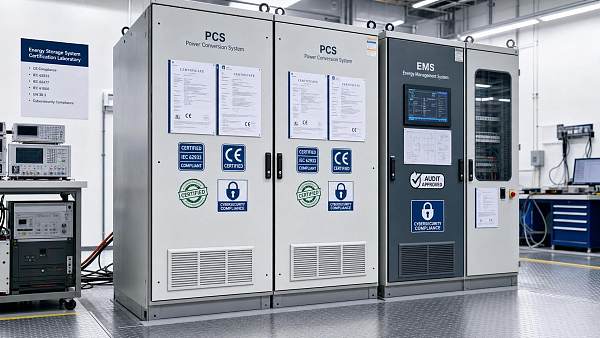
The timing of this development is not specified in the available information, but the signal is clear: the implementation of U.S. FERC Order 2222 is coinciding with a sharp rise in global PCS and EMS orders, and that change matters beyond equipment demand alone. For manufacturers, buyers, certification-related service providers, and supply chain teams, the more relevant issue is that market access rules for distributed resources are translating into procurement pressure, longer delivery timelines for certified units, and closer attention to compliance readiness in active power markets.

What the reported market change confirms
According to Wood Mackenzie’s Q2 2026 Grid Flexibility Report, global orders for PCS and EMS systems increased 41% year-on-year. The reported driver is the implementation of U.S. FERC Order 2222, which enables distributed resources to participate in organized markets. The summary specifically notes that these distributed resources include C&I BESS and EV fleets.
The same report summary indicates that demand is strongest in Texas through ERCOT, in Germany through Bundesnetzagentur auctions, and in Australia through AEMO VPP tenders. It also states that lead times for certified units have extended to 26 weeks.
Why this rule-linked demand shift matters across the chain
For equipment manufacturers and integrators
From an industry perspective, these companies may be affected first because an increase in orders tied to market participation rules can quickly turn compliance status into a delivery constraint. The practical impact is likely to show up in production scheduling, certification sequencing, technical documentation, and customer commitments for certified PCS and EMS units. What deserves closer attention is whether product readiness for organized market participation becomes a deciding factor in order conversion and shipment timing.
For buyers and project procurement teams
Purchasing teams may face pressure not only on availability but also on specification alignment. Where demand is strongest in ERCOT, Bundesnetzagentur-linked procurement environments, and AEMO VPP tenders, buyers may need to scrutinize whether supplier materials, certification status, and technical submissions are adequate for the relevant market pathway. The reported extension of lead times to 26 weeks suggests that procurement planning and delivery scheduling could become more sensitive to certified-unit availability.
For certification, testing, and compliance support providers
Analysis shows that these service providers may see rising demand because the reported bottleneck is not described simply as hardware capacity, but specifically as lead time for certified units. That makes certification workflow, supporting documentation, and test-related readiness commercially relevant. The impact may therefore appear in document review, technical file preparation, and compliance evidence needed by buyers or tender participants.
For supply chain and after-sales service teams
Observably, longer lead times can affect more than initial shipment. Supply chain service providers and after-sales teams may need to pay closer attention to delivery promises, replacement planning, and traceability of certified configurations. Where market participation depends on recognized system capability, downstream service records and version control may become more important in customer-facing support and ongoing compliance management.
What companies should watch next in practical terms
Certification status should be checked earlier
It is more appropriate to understand the current signal as a reminder that certification timing can influence commercial timing. Companies involved in sourcing or bidding should check certification status, supporting reports, and technical documents earlier in the procurement cycle, especially where certified units are a stated constraint.
Bid and tender documents need closer review
Analysis shows that firms targeting active demand areas should watch how requirements are expressed in auction, tender, or organized market participation documents. The available information does not provide detailed execution criteria, so companies should avoid assuming that demand growth alone guarantees smooth market access. Specification alignment and document completeness deserve closer attention.
Delivery planning should reflect longer lead times
The reported 26-week lead time for certified units should be treated as a planning signal rather than a universal rule. Buyers, exporters, and channel partners may need to recheck delivery windows, supplier commitments, and internal scheduling assumptions so that compliance-ready units are not treated as standard inventory.
Rule implementation should be monitored by market, not in general terms
Because the demand concentration mentioned in the report is tied to ERCOT, Bundesnetzagentur auctions, and AEMO VPP tenders, companies should monitor execution language market by market. The input does not provide full rule details for each pathway, so the prudent approach is to track official wording, tender updates, and operational feedback rather than rely on broad assumptions about distributed resource participation.
How this development is best understood at this stage
Observably, this is not just a demand story. It is also an execution signal showing that participation rules for distributed resources can move upstream into equipment ordering, certification lead times, and procurement behavior. At the same time, the available information remains limited to a reported order increase, named demand hotspots, and longer lead times for certified units. That means the market should read this as evidence of rule-linked commercial movement, while continuing to watch for more detailed implementation signals.
A measured reading of the current signal
On balance, this development is more appropriately understood as a concrete market response to rule implementation rather than as a fully settled end-state. The reported increase in PCS and EMS orders, combined with longer lead times for certified units, points to immediate pressure in compliance-sensitive procurement and delivery. Even so, the broader execution impact still requires continued observation through certification practice, tender language, and market feedback.
Basis of this article and points that still require verification
This article is based on the user-provided news title, event timing, and event summary. The specific official source link was not provided in the input, so it still needs ongoing verification against primary materials where available.
For this type of development, relevant source categories would usually include official regulatory announcements, market operator notices, trade or customs authority information, industry association materials, standard-setting documents, and reporting from established industry media. What still needs continued observation includes detailed implementation language, certification practice, tender document changes, industry feedback, and how companies are executing against these requirements in active markets.
Related News
 How Power Flow Algorithms for Grids Improve Stability and Dispatch AccuracyGrid Storage ArchitectPower flow algorithms for grids improve stability, congestion visibility, and dispatch accuracy across BESS, UHV, EV, and hydrogen networks—see how smarter modeling boosts grid decisions.
 FERC Order 2222 Lifts PCS and EMS OrdersGrid Storage ArchitectFERC Order 2222 lifts PCS and EMS orders as certified-unit lead times stretch to 26 weeks. Discover what this means for procurement, compliance, and market-ready delivery.
 When a Bidirectional Power Conversion System Pays OffGrid Storage ArchitectPower conversion system bidirectional designs pay off when arbitrage, demand shaving, grid services, and resilience stack together. Learn when the ROI is strong.
 Japan JIS C 8715-2:2026 Adds RISC-V Firmware Audit RulesGrid Storage ArchitectJapan JIS C 8715-2:2026 adds RISC-V firmware audit rules for PCS and EMS exports to Japan. Learn the new requirements for traceability, PMP, and secure boot compliance.
 TUV Rheinland Tightens PCS and EMS Cybersecurity TemplateGrid Storage ArchitectTUV Rheinland tightens PCS and EMS cybersecurity certification with a new IEC 62443-4-2:2026 SDL audit. Learn how this update may affect Germany and Europe energy storage exports, compliance timing, and certification readiness.
 Power Flow Control Systems: Key Selection FactorsGrid Storage ArchitectPower flow control systems are critical for BESS, EV charging, and grid stability. Discover the key selection factors that improve performance, reliability, and lifecycle value.
 Kehua Releases Grid-Forming Storage PaperGrid Storage ArchitectKehua Releases Grid-Forming Storage Paper, outlining grid-forming PCS functions, weak-grid delivery impact, and compliance signals shaping bids, testing, and project acceptance.
 Technical Comparison Resources for PCS and EMS Selection in BESS ProjectsGrid Storage ArchitectTechnical comparison resources for PCS and EMS selection in BESS projects: compare control logic, thermal safety, grid compliance, and lifecycle value to choose smarter, bankable storage solutions.
 Grid Dispatch Intelligence in Renewable Peak-Shaving ApplicationsGrid Storage ArchitectGrid dispatch intelligence drives smarter renewable peak-shaving by coordinating storage, transmission, EV charging, and hydrogen loads to cut curtailment, protect assets, and boost grid value.
 Can Smart Grid Neural Networks Improve EMS Forecast Accuracy?Grid Storage ArchitectSmart grid neural networks can improve EMS forecast accuracy by refining dispatch, storage timing, and grid response. See where real operational gains and ROI appear.
 DOE Safe Harbor Update Triggers PCS and EMS BuyingGrid Storage ArchitectDOE Safe Harbor Update reshapes PCS and EMS buying for 32 federally funded storage projects. See how new certification and VPP interface rules affect supplier access, procurement, and compliance planning.
 DOE Safe Harbor Update Triggers 70GWh PCS and EMS BuyingGrid Storage ArchitectDOE Safe Harbor update triggers 70GWh energy storage buying, putting PCS and EMS suppliers under new UL 1741 SA and FERC 2222 requirements. See who can bid now.