How Energy Transition Consulting Shapes Bankable Grid Projects
For business evaluators, grid projects now sit at the crossroads of engineering, regulation, and capital discipline.
That is why energy transition consulting has moved from a nice-to-have service to a core decision tool.
A strong advisory process helps convert technical ambition into a finance-ready project story.
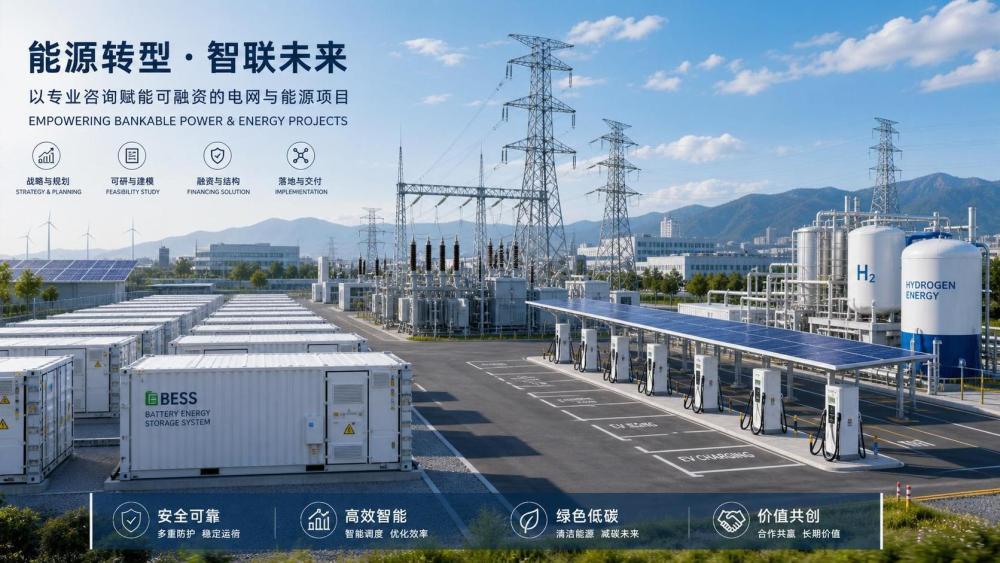
This matters across BESS containers, UHV transmission, hydrogen electrolyzers, and EV charging hubs.
Each asset may look attractive on paper, yet bankability depends on much more than installed capacity.
Lenders and investors want visibility on performance risk, compliance exposure, dispatch value, and lifecycle returns.
Energy transition consulting creates that visibility by connecting operating reality with capital expectations.
In practical terms, it helps answer one central question.
Can this project deliver stable grid value and predictable cash flow under real market conditions?
Why Bankability Starts Before Procurement
Many projects become difficult to finance long before equipment reaches the site.
The real problems usually start with weak assumptions, unclear use cases, or mismatched revenue models.
Energy transition consulting reduces that gap early.
It tests whether a grid asset fits local market design, network constraints, and future operating rules.
This is especially important when projects depend on stacked revenues.
A BESS project may target arbitrage, frequency response, reserve capacity, and grid deferral at once.
Without careful modeling, those value streams can overlap, conflict, or disappear under dispatch priorities.
A good consulting framework also checks whether technical specifications support the commercial promise.
- Cycle life must match projected dispatch frequency.
- Cooling design must support thermal stability and warranty integrity.
- PCS sizing must reflect real response obligations.
- Interconnection timelines must align with capital deployment plans.
When those pieces line up, project finance discussions become far more grounded.
How Energy Transition Consulting De-Risks Complex Grid Assets
Not all grid technologies carry the same risk profile.
Still, energy transition consulting follows a common principle.
It translates technical uncertainty into quantified decision points.
BESS Containers
Storage projects often look bankable because demand is rising quickly.
Yet the details matter more than the headline trend.
Consultants assess LCOS, degradation curves, augmentation timing, fire safety, and control response under actual duty cycles.
They also review standards such as UL 9540A and local grid code obligations.
UHV and Smart Grid Equipment
Transmission assets need a different lens.
Here, energy transition consulting focuses on system resilience, congestion relief, curtailment reduction, and policy alignment.
Bankability improves when the advisory case shows measurable grid stability benefits and long asset relevance.
Hydrogen and EV Infrastructure
Hydrogen electrolyzers and mega charging hubs depend heavily on utilization assumptions.
That is where advisory quality becomes decisive.
Consultants stress-test power sourcing, offtake certainty, demand ramp, and future tariff impacts.
They ask whether the asset works only in a best-case scenario, or across realistic market volatility.
The Core Workstreams Behind a Bankable Project
From recent market shifts, one signal is very clear.
Projects win financing when advisory work is structured, evidence-based, and linked to execution.
Effective energy transition consulting usually covers five core workstreams.
- Technical due diligence for design, performance, and operational fit.
- Regulatory and compliance review across safety, grid connection, and permitting.
- Revenue modeling based on realistic dispatch and market participation rules.
- Risk allocation review across EPC, OEM, O&M, and warranty structures.
- Capital readiness support for lenders, funds, and internal investment committees.
These workstreams are closely linked.
A weak warranty structure can undermine financial projections.
A slow interconnection process can destroy revenue timing.
A poor thermal design can turn a performance issue into a financing issue.
This is exactly why energy transition consulting should not be treated as a final-stage box-checking exercise.
What Business Evaluators Should Look for First
In real project reviews, the fastest way to improve decisions is to focus on a few high-impact questions.
This keeps energy transition consulting practical rather than abstract.
- What exact grid problem does the asset solve?
- Which revenue streams are contracted, merchant, or policy-dependent?
- How sensitive are returns to utilization, curtailment, and efficiency loss?
- Do safety and compliance requirements affect cost or schedule materially?
- Can the project still perform under conservative dispatch assumptions?
- Are counterparties strong enough to support long-term asset confidence?
A disciplined answer set quickly reveals whether a project is finance-ready or still concept-heavy.
It also shows where deeper energy transition consulting can unlock value.
Sometimes the answer is not to reject the asset.
The better move is to redesign the use case, phase the buildout, or tighten risk transfer terms.
A Simple Evaluation Framework for Modern Grid Projects
When comparing opportunities, a simple framework can keep reviews consistent.
The table below summarizes how energy transition consulting supports a bankable decision path.
This kind of structure is useful because it keeps technical enthusiasm tied to measurable investment logic.
Why Specialized Intelligence Matters More Now
The market is no longer simple enough for generic advisory language.
Grid-scale storage, high-voltage transmission, and flexible electrification all interact in faster, tighter ways.
That makes specialized energy transition consulting far more valuable.
A platform like ESGS helps decision teams see the full picture.
It connects battery thermal management, millisecond-level dispatch, transmission bottlenecks, charging flexibility, and hydrogen conversion economics.
More importantly, it turns fragmented technical signals into investment-grade intelligence.
That is what strong energy transition consulting should do in today’s environment.
It should clarify where stability, flexibility, and returns genuinely reinforce each other.
From Technical Promise to Investment Confidence
The strongest projects are rarely the ones with the biggest headline numbers.
They are the ones with a credible operating case, clear compliance path, and defendable return profile.
That is the real value of energy transition consulting.
It does not just explain the transition.
It helps shape projects that can survive due diligence, attract capital, and perform in the field.
In actual business practice, that means starting early, asking harder questions, and using sector-specific intelligence.
When that discipline is in place, modern grid infrastructure becomes easier to evaluate and far easier to finance.
If the goal is to identify bankable grid projects, energy transition consulting is no longer support work. It is part of the investment strategy itself.
Related News
 Frequency Regulation Revenue: How to Evaluate Payback and Market RiskMr. Orion SterlingFrequency regulation revenue explained: learn how to evaluate payback, battery wear, pricing volatility, and market risk to make smarter storage investment decisions.
 How Energy Transition Consulting Shapes Bankable Grid ProjectsMr. Orion SterlingEnergy transition consulting helps turn complex grid assets into bankable projects by reducing risk, improving revenue visibility, and strengthening investor confidence.
 Zero-Carbon Grids: Key Cost Drivers and ROI in 2026Mr. Orion SterlingZero-carbon grids in 2026: uncover the real cost drivers, ROI levers, and hidden risks across BESS, UHV, hydrogen, and EV charging to make smarter, higher-return grid investments.
 LCOS Analysis for Grid-Scale Storage: Which Cost Inputs Matter Most?Mr. Orion SterlingLCOS analysis reveals which cost inputs truly shape grid-scale storage returns. Explore capex, degradation, efficiency, augmentation, and financing to make smarter BESS procurement decisions.
 Distributed Storage vs Centralized Systems: What Changes Grid Resilience?Mr. Orion SterlingDistributed storage vs centralized systems: discover how distributed storage improves grid resilience, speeds outage recovery, reduces local congestion, and supports smarter energy strategy.
 How Renewable Integration Impacts Curtailment, Stability, and ROIMr. Orion SterlingRenewable integration shapes curtailment, grid stability, and ROI. Discover how storage, transmission, hydrogen, and smart controls can reduce losses and improve project returns.
 Renewable Energy Reservoirs: Benefits, Limits, and Grid ValueMr. Orion SterlingRenewable energy reservoirs explained: discover their benefits, limits, and real grid value across batteries, hydrogen, EV fleets, and pumped hydro for smarter energy planning.
 Energy Hubs for Smart Cities: What Makes Projects BankableMr. Orion SterlingEnergy hubs for smart cities become bankable when grid integration, safe storage, realistic revenue, and compliance align. Learn what investors and buyers value most.
 Energy Transition Risks Reshaping Grid Investment in 2026Mr. Orion SterlingEnergy transition risks are reshaping grid investment in 2026. Explore how storage, transmission, charging, and hydrogen risks impact returns, resilience, and bankable assets.
 Energy Market Insights: 5 Price Signals to Watch in 2026Mr. Orion SterlingEnergy market insights for 2026: discover 5 critical price signals shaping storage, grids, EV charging, and hydrogen—and make smarter investment decisions before volatility hits.
 When Energy Transition Consulting Delivers Measurable ROIMr. Orion SterlingEnergy transition consulting delivers measurable ROI by reducing risk, optimizing asset choices, and improving long-term returns across storage, grid, EV charging, and hydrogen projects.
 LCOS Analysis: What Really Drives Battery Project ROI?Mr. Orion SterlingLCOS analysis reveals what truly drives battery project ROI—utilization, degradation, augmentation, efficiency, and financing. Discover how to assess bankability and long-term returns.