How Renewable Integration Impacts Curtailment, Stability, and ROI
Renewable integration is no longer a niche engineering topic. It now shapes project finance, grid reliability, and long-term infrastructure strategy across power markets.
As wind and solar capacity expand, operators face a simple tension. Clean power is abundant at some hours, yet scarce when demand peaks.
That gap drives three board-level questions. How much energy gets curtailed, how stable the grid remains, and whether assets still deliver acceptable returns.
The answer depends on coordination. Storage, transmission, smart controls, hydrogen conversion, and flexible EV charging all influence renewable integration outcomes.
For companies allocating capital into grid-scale systems, this is not only a technical issue. It is a portfolio design problem with direct consequences for bankability.
Why Renewable Integration Starts with Curtailment
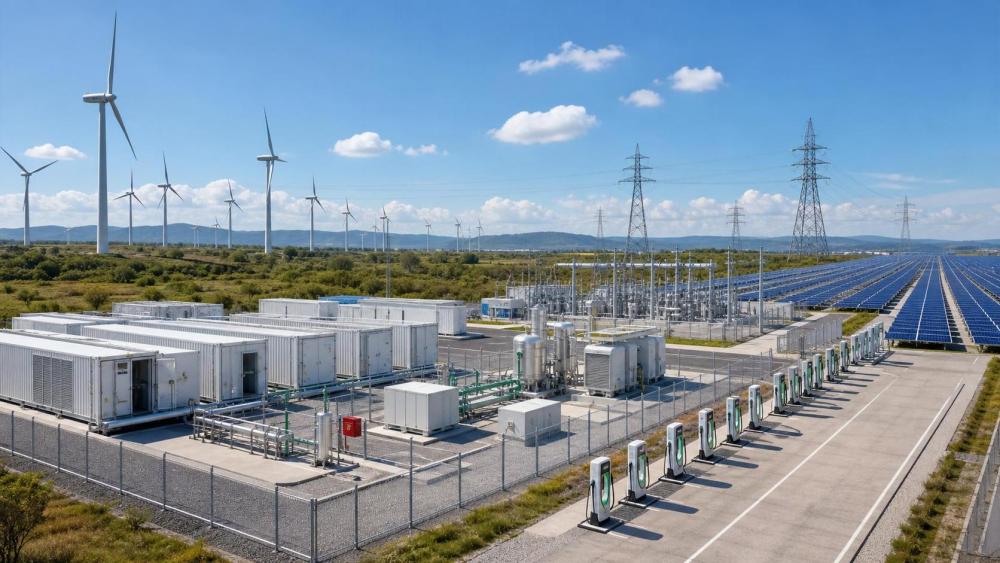
Curtailment happens when available renewable generation cannot be used, stored, or transmitted. In practical terms, valuable clean electricity is left on the table.
This often appears in regions with strong solar output, weak local demand, or limited interconnection capacity. Offshore wind zones can face the same pattern.
Poor renewable integration makes curtailment worse. The system may have generation, but lacks the flexibility to move or reshape that energy in time.
From a business view, curtailment erodes asset utilization. It reduces delivered megawatt-hours, weakens revenue certainty, and distorts the expected value of renewable projects.
It also changes market behavior. Negative pricing, congestion charges, and volatile ancillary service spreads become more common as renewable integration deepens.
Common drivers behind curtailment
- Transmission bottlenecks between renewable sites and load centers.
- Insufficient grid-scale BESS capacity during midday or overnight surplus periods.
- Slow thermal fleet ramping and limited demand-side flexibility.
- Weak forecasting and dispatch coordination across distributed assets.
- Interconnection rules that lag actual renewable integration needs.
The bigger signal is this. Curtailment is rarely caused by too much renewable power alone. It usually reflects too little system flexibility.
How Renewable Integration Changes Grid Stability
Grid stability becomes more complex as inverter-based resources replace conventional rotating machines. Frequency response, voltage support, and fault behavior all evolve.
This does not mean renewable integration is inherently unstable. It means the control architecture must become faster, more digital, and more coordinated.
Battery systems now play a central role. They respond in milliseconds, smooth output swings, and provide synthetic inertia-like services when configured correctly.
Smart grid equipment matters just as much. High-speed switchgear, HVDC links, and advanced protection systems help route power without compromising resilience.
In real operating environments, stability risk usually rises at the edges. Sudden cloud cover, wind ramps, transmission faults, or EV charging surges can expose weak coordination.
What a stable renewable integration strategy includes
- Fast-response BESS with robust thermal management and PCS control.
- Dynamic forecasting that links weather, load, and congestion data.
- Flexible transmission using HVDC and UHV corridors where geography demands it.
- Distributed flexibility from V2G fleets, commercial storage, and controllable demand.
- Safety and compliance frameworks that reduce operational and insurance risk.
This is where system design becomes strategic. Strong renewable integration depends less on a single device and more on how assets behave as one network.
The ROI Equation Behind Renewable Integration
Return on investment improves when renewable integration lifts asset utilization and opens stacked revenue streams. That is the commercial core of the story.
A solar farm paired with storage can reduce curtailment, shift output into higher-priced hours, and qualify for ancillary service payments.
A transmission upgrade can unlock trapped renewable output across a wider region. That changes both delivered energy economics and congestion-related value.
Hydrogen adds another path. When power prices collapse, electrolyzers can absorb excess generation and convert curtailed electricity into a tradable low-carbon fuel.
The same logic applies to mega EV charging and swapping hubs. Managed charging can become a demand-shaping tool instead of a grid stress point.
Key ROI levers executives should track
- Curtailment reduction rate and recovered megawatt-hours.
- Spread capture from peak-valley arbitrage.
- Ancillary service availability and performance penalties.
- Round-trip efficiency, degradation, and LCOS trends.
- Grid access certainty, permitting speed, and compliance costs.
- Revenue diversification across energy, capacity, and flexibility services.
What matters most is integration quality. Renewable integration done poorly can add capex without solving congestion or volatility. Done well, it improves both resilience and returns.
Where Different Technologies Fit in the Same System
Decision-making gets easier when each technology is assigned a clear role. Renewable integration works best when every asset solves a specific timing or location problem.
This layered approach is becoming the new baseline. Single-asset optimization is giving way to system-level renewable integration planning.
What to Prioritize Before Committing Capital
Before approving large investments, focus on operational fit rather than headline capacity. Megawatts alone do not guarantee effective renewable integration.
Start with the local bottleneck. Is the main issue energy shifting, transmission reach, ramp control, or monetizing excess generation?
Then test revenue assumptions against real dispatch conditions. Market spreads, curtailment hours, and ancillary prices can change quickly once more projects connect.
Safety also deserves early attention. Thermal management, fire propagation standards, and grid code compliance materially affect financing and insurance outcomes.
A practical evaluation checklist
- Map where curtailment occurs by hour, season, and node.
- Model renewable integration with storage, transmission, and flexible load together.
- Stress-test ROI under lower spreads and higher connection delays.
- Check compliance pathways for BESS, grid equipment, and hydrogen systems.
- Assess whether digital dispatch tools can scale across mixed asset fleets.
In many cases, the best move is not the biggest buildout. It is the combination that removes the most expensive system constraint first.
The Strategic Takeaway
Renewable integration sits at the center of modern grid economics. It determines whether clean generation is wasted, stabilized, or turned into durable cash flow.
The strongest strategies connect grid-scale BESS, advanced transmission, smart dispatch, hydrogen conversion, and flexible EV infrastructure into one operating logic.
That is how curtailment falls, stability improves, and ROI becomes more defendable. Not through isolated assets, but through coordinated renewable integration.
For organizations shaping future energy portfolios, the next step is clear. Evaluate where flexibility creates the highest system value, then build around that constraint with discipline.
Related News
 Frequency Regulation Revenue: How to Evaluate Payback and Market RiskMr. Orion SterlingFrequency regulation revenue explained: learn how to evaluate payback, battery wear, pricing volatility, and market risk to make smarter storage investment decisions.
 How Energy Transition Consulting Shapes Bankable Grid ProjectsMr. Orion SterlingEnergy transition consulting helps turn complex grid assets into bankable projects by reducing risk, improving revenue visibility, and strengthening investor confidence.
 Zero-Carbon Grids: Key Cost Drivers and ROI in 2026Mr. Orion SterlingZero-carbon grids in 2026: uncover the real cost drivers, ROI levers, and hidden risks across BESS, UHV, hydrogen, and EV charging to make smarter, higher-return grid investments.
 LCOS Analysis for Grid-Scale Storage: Which Cost Inputs Matter Most?Mr. Orion SterlingLCOS analysis reveals which cost inputs truly shape grid-scale storage returns. Explore capex, degradation, efficiency, augmentation, and financing to make smarter BESS procurement decisions.
 Distributed Storage vs Centralized Systems: What Changes Grid Resilience?Mr. Orion SterlingDistributed storage vs centralized systems: discover how distributed storage improves grid resilience, speeds outage recovery, reduces local congestion, and supports smarter energy strategy.
 How Renewable Integration Impacts Curtailment, Stability, and ROIMr. Orion SterlingRenewable integration shapes curtailment, grid stability, and ROI. Discover how storage, transmission, hydrogen, and smart controls can reduce losses and improve project returns.
 Renewable Energy Reservoirs: Benefits, Limits, and Grid ValueMr. Orion SterlingRenewable energy reservoirs explained: discover their benefits, limits, and real grid value across batteries, hydrogen, EV fleets, and pumped hydro for smarter energy planning.
 Energy Hubs for Smart Cities: What Makes Projects BankableMr. Orion SterlingEnergy hubs for smart cities become bankable when grid integration, safe storage, realistic revenue, and compliance align. Learn what investors and buyers value most.
 Energy Transition Risks Reshaping Grid Investment in 2026Mr. Orion SterlingEnergy transition risks are reshaping grid investment in 2026. Explore how storage, transmission, charging, and hydrogen risks impact returns, resilience, and bankable assets.
 Energy Market Insights: 5 Price Signals to Watch in 2026Mr. Orion SterlingEnergy market insights for 2026: discover 5 critical price signals shaping storage, grids, EV charging, and hydrogen—and make smarter investment decisions before volatility hits.
 When Energy Transition Consulting Delivers Measurable ROIMr. Orion SterlingEnergy transition consulting delivers measurable ROI by reducing risk, optimizing asset choices, and improving long-term returns across storage, grid, EV charging, and hydrogen projects.
 LCOS Analysis: What Really Drives Battery Project ROI?Mr. Orion SterlingLCOS analysis reveals what truly drives battery project ROI—utilization, degradation, augmentation, efficiency, and financing. Discover how to assess bankability and long-term returns.