For technical evaluators, energy intelligence is only valuable when it improves real EMS control—not when it adds more dashboards or data noise. The most effective inputs connect battery behavior, thermal conditions, power flow, load variability, and grid response into decisions that reduce risk, improve dispatch accuracy, and protect asset value. This article examines which data streams truly strengthen control logic across storage, charging, transmission, and flexible grid operations.
In grid-scale storage, UHV transmission, EV charging hubs, and hydrogen-linked flexible loads, the core question is practical: which data points change control outcomes within 1 second, 5 minutes, or the next dispatch interval? For ESGS-oriented technical review teams, the answer is not “more data,” but better hierarchy, cleaner timestamps, and data that can be turned into safe operating constraints.
A useful energy intelligence stack should help an EMS do at least four things: keep assets inside thermal and electrical limits, improve forecast-based dispatch, respond to grid events with lower latency, and preserve long-term asset economics. If a data stream does not support one of these four functions, it may belong in analytics, but not in control priority.
What Energy Intelligence Actually Means in EMS Control
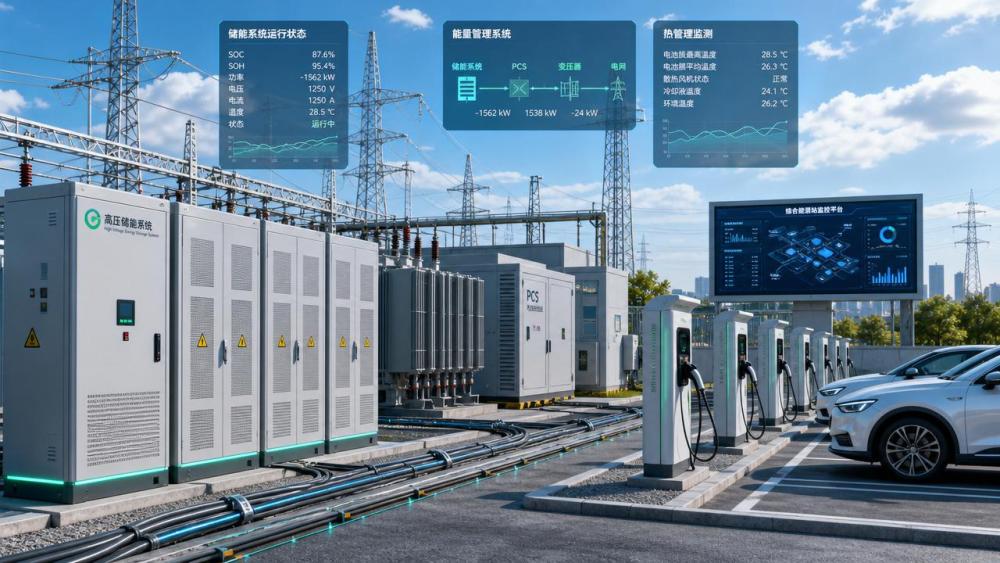
For technical evaluators, energy intelligence should be defined as decision-grade operational data, not business reporting. In a modern EMS, that means time-synchronized inputs that influence charge, discharge, curtailment, reserve holding, load shifting, or fault response across intervals from 100 milliseconds to 15 minutes.
This distinction matters because many projects collect 50 to 200 tags per subsystem, yet only a small subset affects real control quality. Battery containers, PCS units, transformers, switchgear, charging dispensers, electrolyzers, and VPP endpoints all generate telemetry, but only some measurements are stable, validated, and fast enough to support closed-loop action.
The four control outcomes that data must improve
- Safety protection: cell, rack, and system states must prevent overtemperature, overcurrent, overvoltage, and propagation risk.
- Dispatch precision: forecast and real-time data should reduce SOC error, power deviation, and reserve shortfall.
- Grid responsiveness: high-value inputs must support ramp control, frequency response, and event isolation within sub-second to second-level windows.
- Asset preservation: intelligence should limit degradation drivers such as high C-rate stress, thermal gradients above 2°C, and repeated shallow instability cycles.
Which data belongs in the control layer first
The first layer should include hard operational signals: SOC, SOH, rack voltage, current, cell temperature spread, PCS status, breaker status, feeder power, transformer loading, and site import/export values. These inputs typically refresh from 100 milliseconds to 5 seconds, depending on equipment and use case.
The second layer includes predictive signals that influence short-term dispatch, such as 5-minute renewable forecast, 15-minute load forecast, charger occupancy trend, and electrolyzer flexibility window. The third layer contains planning intelligence, including LCOS assumptions, maintenance intervals, and warranty constraints, which should shape strategy but not directly trigger instantaneous control.
A practical filter for evaluators
A simple test is to ask whether a signal changes one of three things: the allowable operating envelope, the dispatch target, or the protection response. If not, the signal may be useful for reporting or diagnostics, but it should not compete for EMS control priority or communication bandwidth.
The Data Streams That Most Improve Storage and Flexible Load Control
Across BESS containers, high-power charging sites, and electrolyzer-connected microgrids, a few data families consistently produce better control outcomes. These are electrochemical state, thermal condition, power conversion behavior, site power flow, and short-horizon variability. Together, they allow the EMS to act with more confidence and fewer conservative buffers.
The table below summarizes which data streams create the most control value and why technical evaluators should rank them above secondary telemetry.
The key conclusion is that the best energy intelligence is closely tied to constraints and control actions. A 1% improvement in SOC accuracy or a 1°C reduction in thermal uncertainty can be more valuable than a large analytics package that arrives too late to influence dispatch.
Battery behavior data that matters most
For BESS containers, the most valuable intelligence begins with reliable SOC and condition-aware power limits. A battery that appears available at 90% SOC may still require derating if internal temperature spread rises from 2°C to 6°C, or if weak strings create voltage imbalance near the top of charge. Control quality depends on seeing that difference early.
Technical evaluators should verify whether the EMS receives battery limits as static nameplate values or dynamic allowable values from the BMS. Dynamic values are materially better. They allow the EMS to dispatch 10 MW when safe, reduce to 7 MW when thermal margin shrinks, and hold reserve when degradation-sensitive conditions appear.
Thermal intelligence is not a secondary layer
In liquid-cooled storage systems, thermal intelligence should not be reduced to ambient temperature and a cabinet alarm. Useful control data includes inlet and outlet coolant temperature, module-level spread, compressor or pump status, and trend rate over the last 3 to 10 minutes. These values can predict whether a dispatch command will remain safe throughout the full interval.
This is especially important during fast charging support, evening peak discharge, and frequency regulation duty where repeated ramps can create localized heating. If the EMS sees only average temperature, it may continue aggressive dispatch while a small thermal hotspot develops outside the mean profile.
Power flow and grid-edge visibility
At the site level, real control improvement comes from synchronized measurement of feeder power, transformer loading, breaker status, voltage, frequency, and reactive power. This is what allows storage, EV chargers, and flexible process loads to act as coordinated grid assets instead of isolated subsystems.
For mega charging or swapping stations, occupancy and queue prediction are also relevant, but only if they are converted into near-term load ramps. Knowing that 40 chargers are installed is not control intelligence. Knowing that load is likely to rise from 3 MW to 6 MW over the next 12 minutes is.
How Control Priorities Change Across BESS, Charging, UHV, and Hydrogen Systems
The same energy intelligence stack cannot be applied uniformly across all infrastructure types. Technical evaluators should expect different control priorities for grid-scale storage, EV hubs, transmission-linked substations, and electrolyzer-based flexible demand. What remains constant is the need to rank signals by control relevance, refresh speed, and operating risk.
The comparison below shows how data importance shifts across common ESGS-aligned asset classes.
This comparison highlights an important point: energy intelligence must be contextual. A transmission node values breaker state and fault timing more than charger queue analytics. A charging hub values near-term demand spikes more than long-range hydrogen scheduling. Good EMS design respects those priorities instead of forcing one universal data model.
BESS: intelligence for safe megawatt dispatch
For storage plants, the best control gains usually come from three improvements: tighter SOC estimation, dynamic thermal limits, and stronger PCS-grid coordination. Even a 2% SOC estimation error can distort available reserve calculation over a 2-hour or 4-hour duration asset. In ancillary service markets, that error can materially affect confidence in bidable capacity.
Evaluators should also test whether alarm data is binary or graded. A graded warning model with thresholds at normal, advisory, derate, and trip gives the EMS more room to act early. Binary alarms often arrive too late and force abrupt power cuts.
Charging hubs: intelligence for volatile, customer-driven loads
At high-power charging stations, the control problem is not only electrical but behavioral. Session start timing, plug-in duration, queue buildup, and V2G participation all affect load shape. The most useful energy intelligence is therefore a mix of electrical telemetry and short-horizon operational prediction, usually over 5-minute, 15-minute, and 60-minute windows.
If the EMS can identify a likely surge before it appears at the main meter, it can pre-charge site storage, hold import below a contract threshold, or stagger lower-priority charging sessions. That is more valuable than historical dashboarding that explains the event after the demand charge has already been incurred.
Hydrogen and flexible industrial loads: intelligence for absorption, not just response
Electrolyzers add a different kind of control value. They can act as controllable sinks for excess solar or wind power, but only within process limits such as minimum stable load, ramp tolerance, and operating efficiency bands. Energy intelligence here should focus on when to absorb power, how quickly to ramp, and when curtailed power becomes economically useful.
For example, a site may tolerate a 10% to 20% load adjustment every few minutes but not rapid oscillation every 5 seconds. That means the EMS should filter grid signals before issuing commands. More data is not better if it causes process instability or equipment stress.
How Technical Evaluators Should Assess Data Quality Before Procurement
The procurement mistake seen most often is judging energy intelligence by dashboard richness rather than control usefulness. Technical evaluators should instead score each vendor or architecture on latency, timestamp consistency, sensor granularity, failure handling, and whether the data can be translated into actionable EMS limits.
Five checkpoints before approval
- Confirm refresh rate by signal class: sub-second, 1-second, 5-second, and 5-minute data should not be mixed without labeling.
- Check timestamp discipline across BMS, PCS, meters, chargers, and SCADA sources; 1 to 3 seconds of drift can weaken event reconstruction.
- Validate data completeness during communication loss, maintenance mode, and restart conditions.
- Verify whether limits are static or dynamically calculated from actual operating state.
- Review how alarms, warnings, and confidence scores are exposed to the EMS.
Common red flags
- Average temperature reported without module spread or hotspot indication.
- SOC reported without confidence interval or recent calibration logic.
- Power commands issued without feedback on actual ramp achievement.
- Forecast data provided without update cycle, error band, or fallback behavior.
- Interconnection meter values arriving too slowly for peak control or fault-aware operation.
Another strong evaluation method is scenario testing. Ask vendors how their control stack performs in six to eight realistic events: a sudden 3 MW charging surge, thermal derating in one battery block, a feeder limit change, renewable forecast error, a breaker open event, or a communications delay lasting 30 seconds. Useful energy intelligence should lead to predictable control behavior in each case.
From Data Collection to Better EMS Decisions
Collecting data is only the starting point. The control advantage appears when data is turned into constraints, priorities, and response logic. That translation layer is where many projects underperform, especially when BESS, EV charging, grid equipment, and flexible industrial loads are integrated after procurement rather than designed together from the beginning.
A practical implementation sequence
- Map all signals to one of three roles: protection, dispatch, or analytics.
- Set quality rules for latency, update frequency, and fallback state.
- Convert raw telemetry into dynamic operating limits and reserve margins.
- Test site-level coordination across storage, chargers, transformers, and flexible loads.
- Review monthly whether the data stack reduced curtailment, penalties, or thermal stress.
When implemented correctly, energy intelligence improves more than one KPI. It can narrow dispatch error, reduce unnecessary cycling, improve demand-cap compliance, strengthen VPP participation, and protect the long-term value of high-capex infrastructure. For technical evaluators, that is the real benchmark: measurable control improvement, not a larger telemetry catalog.
For organizations working across grid-scale BESS containers, UHV-linked systems, mega charging infrastructure, and hydrogen flexibility, the highest-value approach is an intelligence framework built around control relevance. ESGS supports this perspective by connecting thermodynamic behavior, power flow constraints, and dispatch logic into a clearer basis for technical assessment and solution selection.
If you are evaluating EMS architecture, data priorities, or intelligent control pathways for energy infrastructure, now is the right time to refine which inputs truly improve operations. Contact us to discuss your application, request a tailored solution framework, or learn more about practical energy intelligence for safer and more profitable control.
Related News
 How Power Flow Control Systems Hardware Improves Grid StabilityGrid Storage ArchitectPower flow control systems hardware improves grid stability with faster fault response, voltage control, and renewable balancing. See how it supports BESS, EV charging, HVDC, and resilient power networks.
 How to Use an Energy Equipment Specification Format Without Missing Critical DataGrid Storage ArchitectEnergy equipment specification format guide: learn how to capture critical technical, compliance, and lifecycle data, reduce vendor gaps, and improve project delivery with a practical checklist.
 How Power Flow Algorithms for Grids Improve Stability and Dispatch AccuracyGrid Storage ArchitectPower flow algorithms for grids improve stability, congestion visibility, and dispatch accuracy across BESS, UHV, EV, and hydrogen networks—see how smarter modeling boosts grid decisions.
 FERC Order 2222 Lifts PCS and EMS OrdersGrid Storage ArchitectFERC Order 2222 lifts PCS and EMS orders as certified-unit lead times stretch to 26 weeks. Discover what this means for procurement, compliance, and market-ready delivery.
 When a Bidirectional Power Conversion System Pays OffGrid Storage ArchitectPower conversion system bidirectional designs pay off when arbitrage, demand shaving, grid services, and resilience stack together. Learn when the ROI is strong.
 Japan JIS C 8715-2:2026 Adds RISC-V Firmware Audit RulesGrid Storage ArchitectJapan JIS C 8715-2:2026 adds RISC-V firmware audit rules for PCS and EMS exports to Japan. Learn the new requirements for traceability, PMP, and secure boot compliance.
 TUV Rheinland Tightens PCS and EMS Cybersecurity TemplateGrid Storage ArchitectTUV Rheinland tightens PCS and EMS cybersecurity certification with a new IEC 62443-4-2:2026 SDL audit. Learn how this update may affect Germany and Europe energy storage exports, compliance timing, and certification readiness.
 Power Flow Control Systems: Key Selection FactorsGrid Storage ArchitectPower flow control systems are critical for BESS, EV charging, and grid stability. Discover the key selection factors that improve performance, reliability, and lifecycle value.
 Kehua Releases Grid-Forming Storage PaperGrid Storage ArchitectKehua Releases Grid-Forming Storage Paper, outlining grid-forming PCS functions, weak-grid delivery impact, and compliance signals shaping bids, testing, and project acceptance.
 Technical Comparison Resources for PCS and EMS Selection in BESS ProjectsGrid Storage ArchitectTechnical comparison resources for PCS and EMS selection in BESS projects: compare control logic, thermal safety, grid compliance, and lifecycle value to choose smarter, bankable storage solutions.
 Grid Dispatch Intelligence in Renewable Peak-Shaving ApplicationsGrid Storage ArchitectGrid dispatch intelligence drives smarter renewable peak-shaving by coordinating storage, transmission, EV charging, and hydrogen loads to cut curtailment, protect assets, and boost grid value.
 Can Smart Grid Neural Networks Improve EMS Forecast Accuracy?Grid Storage ArchitectSmart grid neural networks can improve EMS forecast accuracy by refining dispatch, storage timing, and grid response. See where real operational gains and ROI appear.